
Sorting arrays is a frequent need in computer science and a task that, in general, can consume large amounts of memory and processor time.
For this reason, choosing an efficient sorting algorithm is an important necessity to improve the speed of our programs.
In this post, we are going to implement the Bubble Sort algorithm (bubble method) to sort an array in ascending and descending order.
The Bubble Sort algorithm is one of the simplest and most well-known methods for sorting an array. It is frequently used as an example in programming courses, which is why its implementation is very common.
However, Bubble Sort is an inefficient algorithm that involves traversing the sample of size N, N times. This translates to a complexity order of O(n^2), making it impractical except for samples with a very small number of elements.
In the next post, we will implement the QuickSort algorithm, a much more efficient sorting algorithm, and compare the results with those obtained using Bubble Sort.
For the Bubble Sort test, we are going to try two samples with numbers from 1 to 100 and 1 to 500 in a random order, on a 16MHz Arduino Nano.
Of course, Arduino is not the most suitable machine for sorting such a large number of elements due to its power and memory limitations. If we really need to sort very large collections, we are probably not using the right processor. But we’re not going to test the algorithms with 10 elements, are we?
Below is the implementation of the ascending and descending Bubble Sort algorithm.
int values100[] = { 3, 53, 70, 56, 18, 85, 27, 14, 37, 94, 9, 55, 40, 60, 52, 61, 15, 65, 13, 8, 57, 97, 69, 4, 35, 82, 22, 73, 59, 68, 78, 24, 21, 36, 71, 80, 74, 39, 17, 12, 29, 76, 49, 51, 30, 90, 88, 2, 84, 50, 62, 28, 77, 43, 5, 16, 58, 26, 32, 34, 1, 75, 66, 95, 38, 89, 67, 87, 100, 54, 92, 81, 25, 83, 46, 33, 23, 45, 96, 99, 79, 48, 11, 31, 7, 6, 19, 91, 93, 44, 47, 98, 86, 41, 63, 20, 72, 10, 42, 64 };
int values100Length = sizeof(values100) / sizeof(int);

int values500[] = { 404, 267, 446, 214, 45, 149, 475, 496, 233, 78, 248, 307, 95, 431, 479, 445, 181, 370, 458, 476, 371, 122, 231, 74, 8, 392, 355, 397, 426, 125, 15, 159, 172, 369, 441, 318, 203, 399, 249, 225, 457, 351, 462, 184, 384, 100, 265, 244, 32, 499, 448, 29, 412, 447, 110, 473, 12, 414, 311, 301, 56, 84, 243, 378, 210, 217, 165, 10, 79, 374, 337, 52, 373, 395, 30, 126, 116, 280, 313, 474, 157, 6, 467, 459, 381, 129, 482, 13, 179, 167, 72, 68, 112, 194, 205, 97, 342, 142, 4, 418, 22, 440, 430, 364, 82, 483, 158, 198, 124, 259, 20, 312, 241, 254, 456, 361, 5, 245, 281, 376, 461, 274, 219, 348, 235, 23, 328, 2, 136, 291, 455, 302, 107, 415, 393, 43, 427, 211, 223, 168, 340, 87, 286, 133, 228, 354, 182, 204, 67, 419, 63, 270, 463, 60, 49, 358, 362, 102, 330, 242, 406, 108, 221, 83, 300, 363, 166, 290, 389, 436, 263, 34, 487, 377, 106, 491, 434, 257, 207, 417, 47, 379, 343, 500, 339, 403, 390, 61, 495, 262, 128, 132, 293, 94, 69, 143, 279, 375, 421, 109, 237, 310, 432, 218, 161, 150, 470, 200, 121, 464, 494, 443, 466, 252, 33, 105, 173, 344, 275, 388, 289, 333, 409, 452, 118, 315, 489, 283, 433, 442, 439, 114, 334, 229, 304, 175, 253, 216, 236, 256, 70, 169, 321, 365, 405, 366, 91, 380, 37, 212, 429, 336, 141, 308, 90, 492, 31, 460, 324, 387, 156, 120, 24, 183, 401, 81, 51, 288, 3, 367, 246, 498, 39, 386, 36, 192, 352, 292, 451, 294, 50, 326, 345, 76, 319, 360, 335, 306, 48, 239, 309, 468, 331, 226, 385, 347, 295, 44, 89, 497, 438, 332, 297, 346, 25, 199, 485, 469, 55, 402, 193, 284, 264, 135, 7, 14, 53, 197, 88, 201, 232, 258, 234, 481, 255, 9, 186, 59, 162, 18, 98, 93, 154, 73, 327, 278, 230, 131, 145, 26, 465, 103, 220, 19, 316, 177, 407, 146, 42, 153, 144, 99, 117, 28, 62, 148, 282, 453, 137, 208, 424, 450, 1, 477, 164, 368, 119, 21, 396, 127, 484, 277, 130, 437, 111, 206, 64, 391, 322, 151, 372, 188, 191, 57, 160, 383, 411, 180, 104, 16, 147, 170, 285, 350, 394, 71, 190, 54, 251, 261, 272, 320, 196, 338, 425, 227, 178, 420, 123, 174, 276, 480, 138, 80, 486, 454, 490, 435, 400, 77, 444, 323, 140, 171, 139, 195, 260, 314, 92, 17, 449, 222, 187, 296, 96, 40, 58, 423, 152, 11, 269, 359, 329, 422, 410, 155, 250, 101, 240, 213, 478, 273, 189, 27, 471, 356, 416, 238, 35, 41, 398, 113, 268, 46, 215, 85, 488, 325, 163, 202, 247, 341, 382, 299, 185, 176, 224, 472, 115, 349, 271, 303, 287, 408, 428, 65, 134, 75, 305, 66, 298, 357, 38, 266, 353, 209, 493, 317, 86, 413 };
int values500Length = sizeof(values500) / sizeof(int);

void printArray(int* x, int length)
{
   for (int iCount = 0; iCount < length; iCount++)
   {
      Serial.print(x[iCount]);
      Serial.print(',');
   }
}

void setup()
{
   Serial.begin(115200);

   Serial.println("Sorting 100 values");
   long timeCount = micros();
   BubbleSortAsc(values100, values100Length);
   timeCount = micros() - timeCount;
   printArray(values100, values100Length);
   Serial.println();
   Serial.print(timeCount);
   Serial.println("us");

   Serial.println("");
   Serial.println("Sorting 500 values");
   timeCount = micros();
   BubbleSortAsc(values500, values500Length);
   timeCount = micros() - timeCount;
   printArray(values500, values500Length);
   Serial.println();
   Serial.print(timeCount);
   Serial.println("us");
}

void loop()
{

}

void BubbleSortAsc(int* values, int length)
{
   int i, j, flag = 1;
   int temp;
   for (i = 1; (i <= length) && flag; i++)
   {
      flag = 0;
      for (j = 0; j < (length - 1); j++)
      {
         if (values[j + 1] < values[j])
         {
            temp = values[j];
            values[j] = values[j + 1];
            values[j + 1] = temp;
            flag = 1;
         }
      }
   }
}

void BubbleSortDesc(int* values, int length)
{
   int i, j, flag = 1;
   int temp;
   for (i = 1; (i <= length) && flag; i++)
   {
      flag = 0;
      for (j = 0; j < (length - 1); j++)
      {
         if (values[j + 1] > values[j])
         {
            temp = values[j];
            values[j] = values[j + 1];
            values[j + 1] = temp;
            flag = 1;
         }
      }
   }
}
And the results we get when running the benchmark.
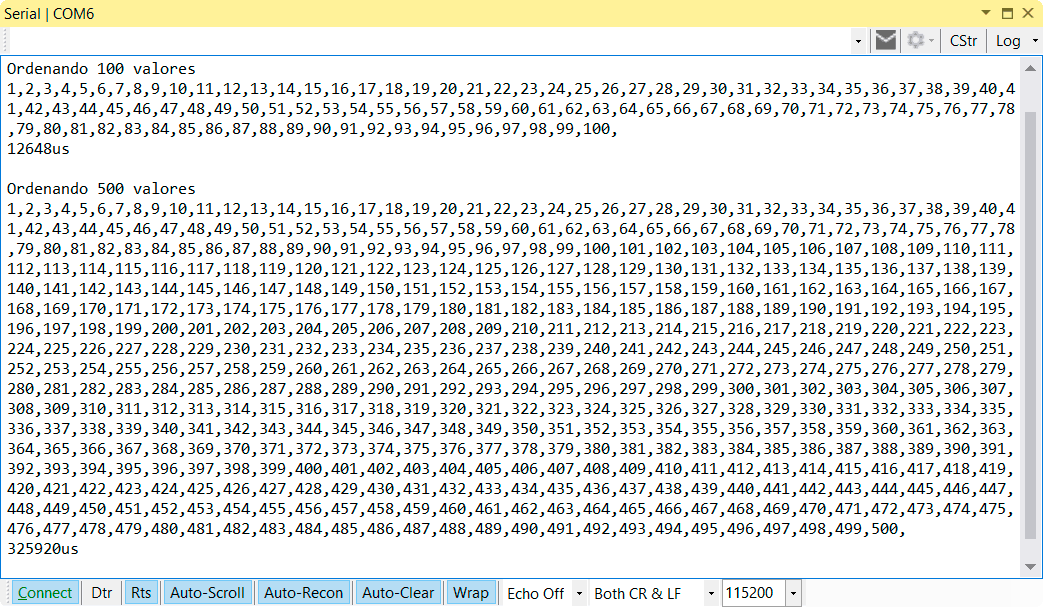
The time obtained is 12.65ms for the 100-element sample, and 325.92ms for the 500-element sample. As we can see, sorting 5 times more elements costs 25.75 times more, which fits the O(n^2) we mentioned earlier (math still works and the world can keep spinning).
In the next post, we will implement the QuickSort algorithm, a much more efficient sorting algorithm.
Download the Code
All the code from this post is available for download on Github.