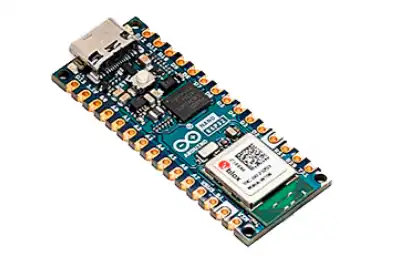
Arduino has presented its new Arduino Nano ESP32 development board model. A well-deserved facelift for one of Arduino’s most popular models, which becomes much more powerful and incorporates WiFi and Bluetooth.
A few days ago we discussed the new Arduino UNO R4 Minima and WiFi boards Discover the new Arduino UNO R4 Minima and WiFi boards. Now, Arduino surprises us with this renewed version of the Arduino Nano.
As the model name indicates, the most interesting point of the new model is that it features a powerful Espressif ESP32-S3 processor, the flagship SoC from the Chinese manufacturer.
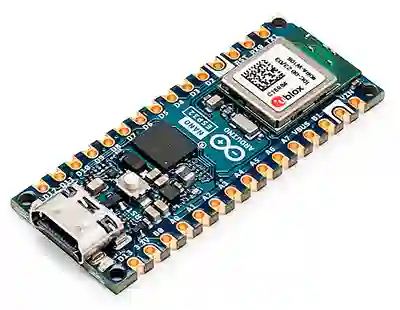
The ESP32-S3 is an old friend of the blog. You can read more about it in the article ESP32-S3 or in the section ESP8266/ESP32
This is not the first time Arduino includes an ESP32 in one of its models. We already saw it, for example, in the new Arduino UNO R4. But, until now it had been in a dual CPU configuration, where the ESP32 handled WiFi connectivity.
The Arduino Nano ESP32 is the first official Arduino board that mounts an ESP32 as the main processor. We assume that, as the saying goes, if you can’t beat them, join them. 😊
{ “CPU and Memory”: [ { “label”: “Processor”, “value”: [“u-Blox NORA-W106-10B”, “based on dual-core ESP32-S3 Xtensa LX7 @240 MHz”] }, { “label”: “Memory”, “value”: [“512 KB SRAM”, “384 KB ROM”, “8 MB PSRAM”, “16 MB flash”] } ], “Connectivity”: [ { “label”: “WiFi”, “value”: “4” }, { “label”: “Bluetooth”, “value”: “5.0” }, { “label”: “USB”, “value”: “Type-C for power and programming” } ], “Devices”: [ { “label”: “Connections”, “value”: “2x 15-pin headers” }, { “label”: “GPIO”, “value”: “14x” }, { “label”: “PWM”, “value”: “5x” }, { “label”: “ADC”, “value”: “8x” }, { “label”: “Interfaces”, “value”: “2x UART, 1x I2C, 1x SPI” }, { “label”: “HID Support”, “value”: “Emulate keyboard and mouse” }, { “label”: “Button and LEDs”, “value”: “Reset button and 2 LEDs” } ], “Power and Dimensions”: [ { “label”: “Operating Voltage”, “value”: “3.3V” }, { “label”: “Current per I/O Pin”, “value”: “40 mA output, 28mA input” }, { “label”: “Power Supply”, “value”: “5V via USB, 6-21V via Vin pin” }, { “label”: “Dimensions”, “value”: “45 x 18 mm” } ] }
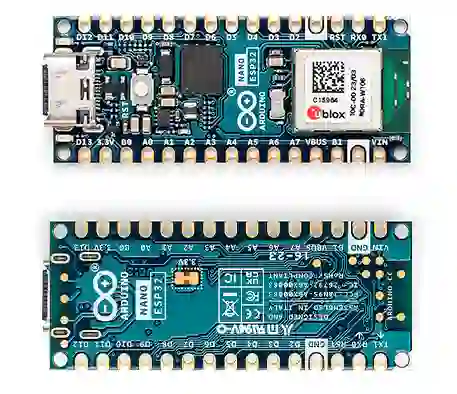
One of the most notable aspects of the Arduino Nano ESP32 is that it maintains the same form factor as the original Arduino Nano. It is important to note that the pinout and voltages are not compatible. Therefore, a direct replacement is not possible.
However, in terms of GPIO, connections, and communication ports, the Arduino Nano ESP32 barely exploits half of the ESP32-S3’s potential. This is a consequence of maintaining the same size. A decision that in my opinion is correct, but results in a very limited number of pins.
Regarding software, the Arduino Nano ESP32, of course, is compatible with the entire Arduino environment and the C++ language. On the other hand, the company places special emphasis on compatibility with MicroPython and with Arduino’s proprietary Cloud, Arduino IoT Cloud.
In this way, the Arduino Nano once again positions itself as an attractive option for the domestic, DIY, and STEAM education sectors, sectors it is progressively targeting.
Regarding price, the Arduino Nano ESP32 enters the market at €18 plus shipping. A reasonable price, but higher than what we are used to from Arduino for its Nano series, which traditionally were in the 9-10€ range.
As we are accustomed to with Arduino, it is expected that the documentation, support, and ease of use of the new model will be excellent. But above all, as usual with the brand’s novelties, it will have the support of the huge and great community. These are, without a doubt, the strongest points of Arduino’s proposals.
This compensates, to some extent, for the shortcomings compared to the competition. And ultimately, the new Arduino Nano ESP32 is a board that mounts an ESP32-S3, like the ones we have found for some time from many other manufacturers. But with fewer features and more than triple the price.
In any case, the new Arduino Nano ESP32 is an interesting board, and a very welcome new step in the modernization of Arduino’s traditional models to more current technologies, like the Arduino UNO and the Arduino R4.
Interestingly, it also signifies the consolidation of the ESP32 as the reference chip of the moment. Something that, modesty aside, we have been saying for a while on the blog 😉.
The new Arduino Nano ESP32 is already available in the company’s store. For more technical details and getting started instructions, you can consult the official documentation.
References: