
In the previous post, we saw the Bubble Sort algorithm as an example of a very common but inefficient algorithm for sorting an array.
In this post, we are going to implement the QuickSort algorithm, both ascending and descending. Quick Sort is a much more modern and efficient sorting algorithm. In fact, it is the standard sorting algorithm in C#.
QuickSort has an average complexity of O(n•log n) and O(n^2) in the worst case. In comparison, less efficient algorithms like Bubble Sort or Insertion Sort have O(n^2) both on average and in the worst case.
The QuickSort algorithm allows for a simple implementation in C++ that can work without issues on a processor like Arduino.
//1540us
int values100[] = { 3, 53, 70, 56, 18, 85, 27, 14, 37, 94, 9, 55, 40, 60, 52, 61, 15, 65, 13, 8, 57, 97, 69, 4, 35, 82, 22, 73, 59, 68, 78, 24, 21, 36, 71, 80, 74, 39, 17, 12, 29, 76, 49, 51, 30, 90, 88, 2, 84, 50, 62, 28, 77, 43, 5, 16, 58, 26, 32, 34, 1, 75, 66, 95, 38, 89, 67, 87, 100, 54, 92, 81, 25, 83, 46, 33, 23, 45, 96, 99, 79, 48, 11, 31, 7, 6, 19, 91, 93, 44, 47, 98, 86, 41, 63, 20, 72, 10, 42, 64 };
int values100Length = sizeof(values100) / sizeof(int);

//9760us
int values500[] = { 404, 267, 446, 214, 45, 149, 475, 496, 233, 78, 248, 307, 95, 431, 479, 445, 181, 370, 458, 476, 371, 122, 231, 74, 8, 392, 355, 397, 426, 125, 15, 159, 172, 369, 441, 318, 203, 399, 249, 225, 457, 351, 462, 184, 384, 100, 265, 244, 32, 499, 448, 29, 412, 447, 110, 473, 12, 414, 311, 301, 56, 84, 243, 378, 210, 217, 165, 10, 79, 374, 337, 52, 373, 395, 30, 126, 116, 280, 313, 474, 157, 6, 467, 459, 381, 129, 482, 13, 179, 167, 72, 68, 112, 194, 205, 97, 342, 142, 4, 418, 22, 440, 430, 364, 82, 483, 158, 198, 124, 259, 20, 312, 241, 254, 456, 361, 5, 245, 281, 376, 461, 274, 219, 348, 235, 23, 328, 2, 136, 291, 455, 302, 107, 415, 393, 43, 427, 211, 223, 168, 340, 87, 286, 133, 228, 354, 182, 204, 67, 419, 63, 270, 463, 60, 49, 358, 362, 102, 330, 242, 406, 108, 221, 83, 300, 363, 166, 290, 389, 436, 263, 34, 487, 377, 106, 491, 434, 257, 207, 417, 47, 379, 343, 500, 339, 403, 390, 61, 495, 262, 128, 132, 293, 94, 69, 143, 279, 375, 421, 109, 237, 310, 432, 218, 161, 150, 470, 200, 121, 464, 494, 443, 466, 252, 33, 105, 173, 344, 275, 388, 289, 333, 409, 452, 118, 315, 489, 283, 433, 442, 439, 114, 334, 229, 304, 175, 253, 216, 236, 256, 70, 169, 321, 365, 405, 366, 91, 380, 37, 212, 429, 336, 141, 308, 90, 492, 31, 460, 324, 387, 156, 120, 24, 183, 401, 81, 51, 288, 3, 367, 246, 498, 39, 386, 36, 192, 352, 292, 451, 294, 50, 326, 345, 76, 319, 360, 335, 306, 48, 239, 309, 468, 331, 226, 385, 347, 295, 44, 89, 497, 438, 332, 297, 346, 25, 199, 485, 469, 55, 402, 193, 284, 264, 135, 7, 14, 53, 197, 88, 201, 232, 258, 234, 481, 255, 9, 186, 59, 162, 18, 98, 93, 154, 73, 327, 278, 230, 131, 145, 26, 465, 103, 220, 19, 316, 177, 407, 146, 42, 153, 144, 99, 117, 28, 62, 148, 282, 453, 137, 208, 424, 450, 1, 477, 164, 368, 119, 21, 396, 127, 484, 277, 130, 437, 111, 206, 64, 391, 322, 151, 372, 188, 191, 57, 160, 383, 411, 180, 104, 16, 147, 170, 285, 350, 394, 71, 190, 54, 251, 261, 272, 320, 196, 338, 425, 227, 178, 420, 123, 174, 276, 480, 138, 80, 486, 454, 490, 435, 400, 77, 444, 323, 140, 171, 139, 195, 260, 314, 92, 17, 449, 222, 187, 296, 96, 40, 58, 423, 152, 11, 269, 359, 329, 422, 410, 155, 250, 101, 240, 213, 478, 273, 189, 27, 471, 356, 416, 238, 35, 41, 398, 113, 268, 46, 215, 85, 488, 325, 163, 202, 247, 341, 382, 299, 185, 176, 224, 472, 115, 349, 271, 303, 287, 408, 428, 65, 134, 75, 305, 66, 298, 357, 38, 266, 353, 209, 493, 317, 86, 413 };
int values500Length = sizeof(values500) / sizeof(int);

void printArray(int* x, int length)
{
   for (int iCount = 0; iCount < length; iCount++)
   {
      Serial.print(x[iCount]);
      Serial.print(',');
   }
}

void setup()
{
   Serial.begin(115200);

   Serial.println("Sorting 100 values");
   long timeCount = micros();
   QuickSortAsc(values100, 0, values100Length - 1);
   timeCount = micros() - timeCount;
   printArray(values100, values100Length);
   Serial.println();
   Serial.print(timeCount);
   Serial.println("us");

   Serial.println("");
   Serial.println("Sorting 500 values");
   timeCount = micros();
   QuickSortAsc(values500, 0, values500Length - 1);
   timeCount = micros() - timeCount;
   printArray(values500, values500Length);
   Serial.println();
   Serial.print(timeCount);
   Serial.println("us");
}

void loop()
{

}

void QuickSortAsc(int* arr, const int left, const int right)
{
   int i = left, j = right;
   int tmp;

   int pivot = arr[(left + right) / 2];
   while (i <= j)
   {
      while (arr[i]<pivot) i++;
      while (arr[j]>pivot) j--;
      if (i <= j)
      {
         tmp = arr[i];
         arr[i] = arr[j];
         arr[j] = tmp;
         i++;
         j--;
      }
   };

   if (left<j)
      QuickSortAsc(arr, left, j);
   if (i<right)
      QuickSortAsc(arr, i, right);
}

void QuickSortDesc(int* arr, const int left, const int right)
{
   int i = left, j = right;
   int tmp;

   int pivot = arr[(left + right) / 2];
   while (i <= j)
   {
      while (arr[i]>pivot) i++;
      while (arr[j]<pivot) j--;
      if (i <= j)
      {
         tmp = arr[i];
         arr[i] = arr[j];
         arr[j] = tmp;
         i++;
         j--;
      }
   };

   if (left<j)
      QuickSortDesc(arr, left, j);
   if (i<right)
      QuickSortDesc(arr, i, right);
}
And these are the benchmark results, performed on an Arduino Nano at 16Mhz. 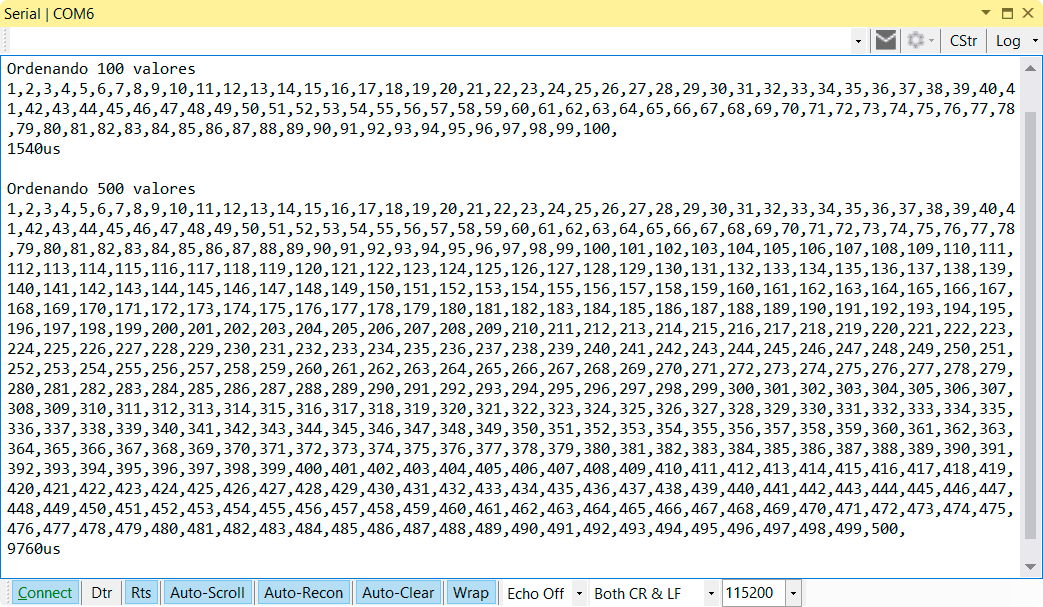 The time to sort the 100-element sample with QuickSort is 1.54ms compared to 12.65ms with Bubble Sort, that is, 8.21 times faster. In the case of the 500-element sample, the time for QuickSort is 9.76ms compared to 325.92ms with Bubble Sort, 33.39 times faster in favor of QuickSort.
As we can see, QuickSort is one of the most efficient sorting algorithms, and its implementation is simple enough not to be an impediment even for simple processors like Arduino.
QuickSort in a Library
What if we put it in a library to make it more convenient to use? Of course, here is a QuickSort library for Arduino. Enjoy it!
Download the Code
All the code from this post is available for download on Github.