
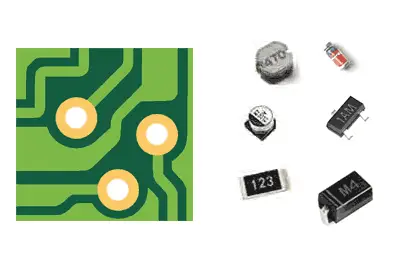
We continue delving into the world of PCBs by looking at some of the common electronic components we will encounter when designing our PCBs.
In previous posts, we have seen the parts of a PCB and the internal structure of a PCB by looking at what PCB layers are, and the differences between PTH and SMD components.
By now, we should be very clear that a PCB is a simple and compact way to make electrical connections, replacing traditional wires. But, by itself, a PCB is not very useful (or rather, useless).
A PCB needs components to form an electronic circuit and perform the action for which it was designed. Therefore, the components mounted on the PCB are equally (or more) important during the PCB design than the PCB itself.
Given the importance of components, we couldn’t have a section on PCB design without seeing, even briefly, some of the types of components we will commonly find when creating or reviewing PCB schematics.
Let’s emphasize “briefly” because, of course, there is an almost infinite number of components and models. It would be impossible to create and maintain a list of all of them. But, at least, it is interesting to make a list as an introduction, with some basic components and their common models in the domestic and maker field.
Here we clarify again that by “common,” we mean that you can find and buy them easily and cheaply from sellers like eBay or AliExpress. This does not mean (not by a long shot) that it is the best model or the most used in the professional field. But you will encounter them frequently.
Of course, most of these components will be available in both PTH and SMD formats, although in this post we will pay more attention to SMD models. And finally, we can start to see our list of common components in PCB designs.
Passive Components
Resistors
The most common passive component in any electrical circuit. As representatives of Ohm’s Law, their function is to establish a relationship between electrical current and voltage. It’s hard to think of a PCB that doesn’t contain at least one resistor.
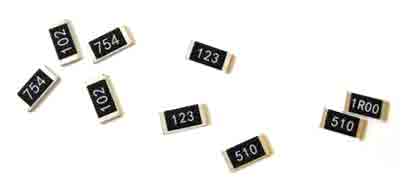
We can find SMD resistors from 10R to 910K, in different sizes, formats, and power ratings.
Capacitors
Another passive element, basic in any PCB. The variation (derivative) of the voltage across a capacitor is equal to the current flowing through it. Capacitors are common components in filtering, signal decoupling. We can find SMD capacitors compatible with voltages up to 6V 6.3V 10V 16V 25V 35V 50V.
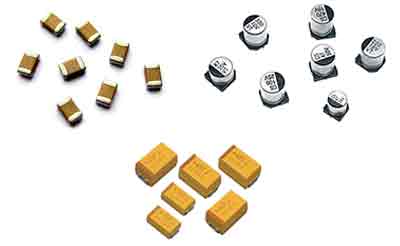
Ceramic capacitors give ranges from 270pF to 47uF. For higher capacitances, we have electrolytic capacitors from 22uF to 470uF (note: they have polarity). Finally, the compact but expensive tantalum capacitors, which we can easily find for 10uF to 470uF.
Inductors
The third and final passive component. In inductors, or coils, the variation of current is equal to the voltage, their behavior being opposite to that of capacitors. Their use is less frequent in beginner-level circuits, but they are widely used components for filtering, voltage changes, and creating oscillator circuits.
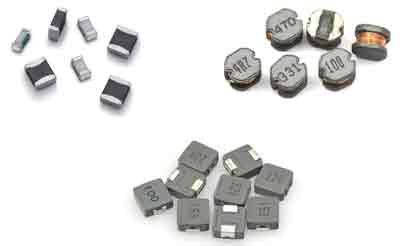
You can find them in ceramic formats for inductances from 1uH to 100uH. For higher inductances, we have SMD wound core inductors from 2.2uH to 470uH.
Diodes
Electronic element that presents a much higher resistance to the flow of electricity in one direction than in the other.
Rectifiers
They are low-speed diodes with high current ratings. They are widely used in power applications, such as AC-DC converters, rectifiers, or flyback diodes to protect electronics from inductive loads.
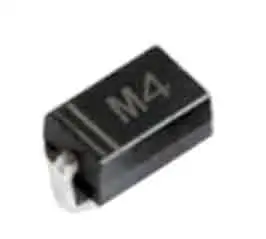
The popular 1N400x (or Mx) series are widely used for different voltages up to 50V (1N4001 M1), 400V (1N4004 M4), up to 1000V (1N4007 M7). They are not suitable for applications above 10 KHz. They have a voltage drop of 0.7V.
Zener
It is a heavily doped silicon diode designed to operate in the reverse region. Its main function is that, when reverse biased, they impose a constant and almost invariant voltage to variations in load or temperature. They are a fundamental part of voltage regulators, voltage references.
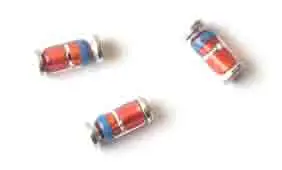
There is a wide variety of models with similar characteristics, but we will mention the 1N4148 LL34 1/2W, available for reverse voltages from 3V to 24V.
Schottky
A diode that replaces the P-N semiconductor junction with a metal-semiconductor junction. Its main function is to provide fast switching speed and a lower voltage drop. As a disadvantage, they have a lower current carrying capacity and withstand lower reverse voltages.
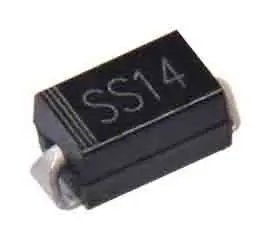
For example, the Schottky diode SS14 1N5819 is common.
LED
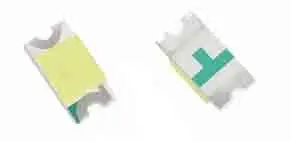
Well-known to all, a Light Emitting Diode is a diode in which the change in electron state is used to emit light. Available in different sizes and colors, which is determined by the voltage drop for which it is designed.
Varistor
A varistor (variable resistor) is an electronic component whose resistance decreases when the voltage applied to it increases. They are frequently used as voltage spike limiters.
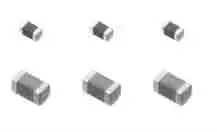
They have a fast response time (5-25ns) and we can find them for voltages from 14V to 550V. As a disadvantage, they degrade with use, so they have reduced reliability.
Crystals
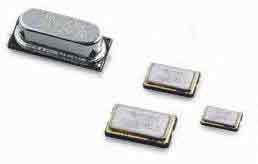
Crystals or resonators are used to generate frequencies, which are then used by other devices such as processors. We can find them between 3.2 MHz and 400 MHz.
Transistors
Probably the most important electronic devices, and old acquaintances of the blog. As we know, their main use is as amplifiers or as electronic switches.
BJT Transistors
Among NPN transistors, the 2N3904 for 40V and 0.2A is common, and its bigger brother, the very popular 2N2222 for 40V and up to 1A.
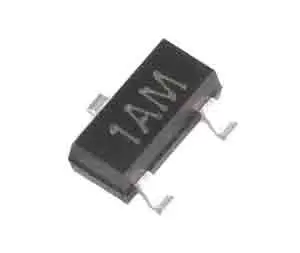
In PNP format, we have the equivalents 2N3906 for 40V and 0.2A, the 2N2905/2N2907 for 40V and 0.6A, as well as the BC807, for 45V and 0.5A.
MOSFET Transistors
In N-channel MOSFET transistors, the AO3402 A29T is very popular, for 30V and up to 4A.
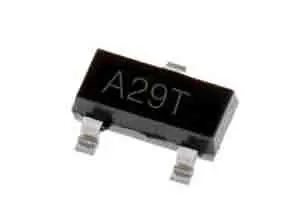
On the other hand, in P-channel we have its equivalent AO3401 A19T for 30V and up to 4.2A. The more economical AO3413 for 20V and up to 2.4A is also common.
Other Integrated Circuits
Voltage Regulators
As their name indicates, they serve to establish a constant voltage that we will use, normally, to power a device or use as a reference.
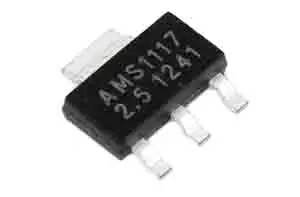
The 78M05 or L78M05 for up to 0.5A are common. The LM1117/AMS1117 and similar are also popular, for up to 1A. Finally, the LM317 (LM317D2, LM317D2T…), for up to 1.5A.
Operational Amplifiers
A widely known component, a Swiss army knife of electronics that serves not only to compare voltages but can also be used in amplifiers, adders, integrators…
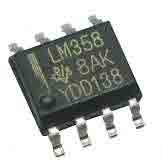
A very common operational amplifier is the LM358, as well as the popular NE5532, the LM1458, or the TL072 family.
Optocoupler
Used to connect two electronic parts while maintaining galvanic isolation between them, for which they use light to transmit information.
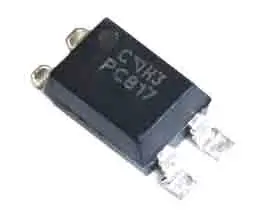
Here we find the popular PC817 and similar (PC817/C, EL817C, …)
Other Components
Fuses
Protection elements for our circuits. Thus we find rupture fuses, which interrupt service when a certain current passes through them, or thermal fuses that interrupt service when they exceed a temperature for a certain time.
Microswitches
Also known to all, a switch, but tiny. Some are maintained action (properly a switch) and others are momentary action (pushbutton), which in turn can be normally open or closed.
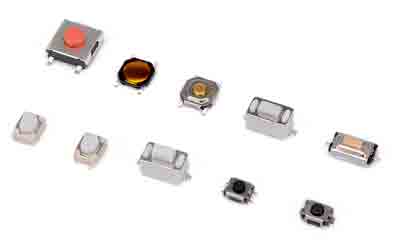
Notable are the SPDT (single pole, double throw) devices, which are switches that have at least 3 pins, and by acting on them we can choose more than one option.
Connectors
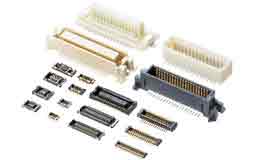
Connectors are another typical component of a PCB, and there are so many that it would deserve its own post. So we limit ourselves to mentioning them and indicating that they are the way to make the cable connections we need for our PCB.
Conclusion
We have made a mini-summary of some of the main types and families of components we will find when designing or analyzing a PCB design, so that we recognize them and know how to identify them.
Of course, as we said, there are thousands and thousands of types, both in SMD and PTH. But these are some of the common ones because they are easy and cheap to buy. So we will also find them.
Of course, we can also find them in a great variety of sizes. This is precisely what we will dedicate the next post to. See you soon!
