We continue with the 3D design and printing section by looking at a debate as controversial as which is better: direct drive or Bowden printers?
The last posts have been dedicated to understanding the workings of an FFF 3D printer, its kinematics, and the parts and components that make it up.
In them, we’ve seen that the “trick” of our 3D printer is to position the extrusion head relative to the print bed precisely. We’ve also seen that the material to be melted is fed into the head by the extruder.
If you’re observant, you’ll notice that in some of the diagrams and images we’ve already seen, the extruder appears right above the hotend, while in others, it appears on the frame.
Well, this is precisely the difference between a direct drive printer and a Bowden printer. And, of course, each of these configurations has its own advantages and disadvantages, as well as its defenders and detractors.
Since it’s a frequent and interesting debate, and a common query in the world of FFF 3D printing, we’re going to dedicate a post to looking at the differences between both technologies.
Difference Between Direct Drive and Bowden
Direct Drive Printers
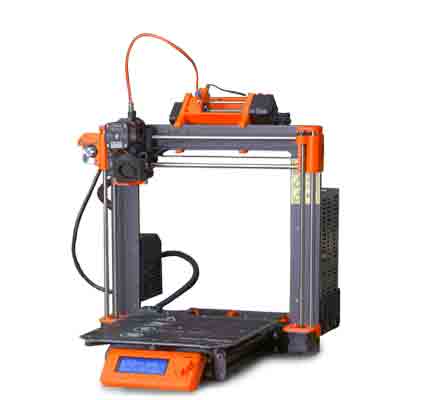
In a direct drive printer, the extruder is located right above the extrusion head, on the same moving carriage, moving solidly with it.
An example of a direct drive printer is the popular and well-known Prusa Mk3, where we see the extruder motor mounted right above the head.
Bowden Printers
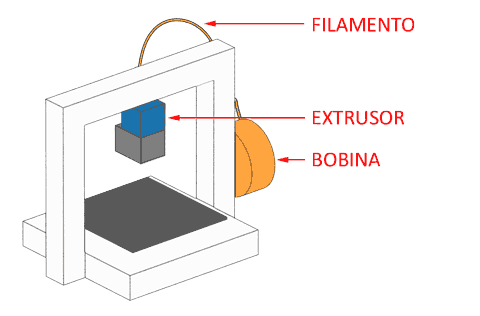
On the contrary, in a Bowden printer the extruder is located on the frame. The filament is guided from the extruder to the extrusion head through a plastic tube called (guess what) a Bowden tube.
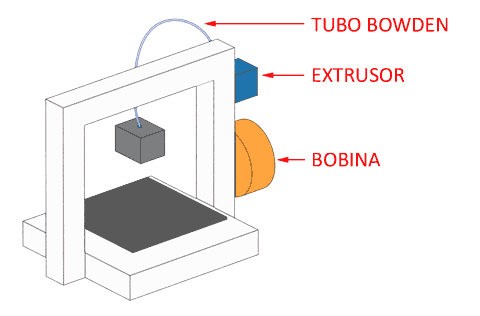
An example of a Bowden printer is our beloved Anycubic i3 Mega, which we saw back in this post.
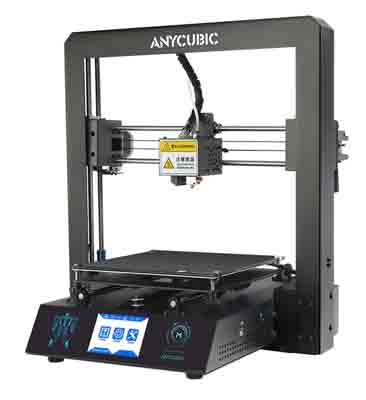
As we can see in the image, the carriage does not contain the extruder, and instead it is located on the right, on the frame of the printer’s structure.
In reality, direct drive printers also have a “small Bowden tube” to guide the filament between the end of the extruder and the head. But its length is a few centimeters, so it doesn’t really have an effect.
Advantages and Disadvantages
As we said at the beginning, each configuration has its advantages and disadvantages, which leads to debates about which is better. In reality, these advantages are quite simple and boil down to whether it’s better to have better control of the filament or to have less moving weight.
Thus, direct drive printers have the advantage of having greater control over the filament, because the extruder is right above the head and doesn’t have to “deal” with a long piece of filament moving inside the Bowden tube.
This translates into an ability to print smaller and finer details, and greater ease in avoiding certain typical printing problems like the troublesome oozing (fine strings that appear on parts).
For their part, Bowden printers have the advantage of not having to move the weight of the extruder. In this way, the moving carriage only has to move the print head, while the weight, especially of the extruder motor, is transferred to the frame.
This implies that the head will experience less vibration and, in theory, we can achieve higher printing speeds. Furthermore, it allows the use of lighter frames and moving components.
Finally, in the case of printers with multiple filaments, they generally tend to have a Bowden-type configuration. Otherwise, the weight and size of multiple extruders on the carriage would become more problematic.
Conclusion
So, in short, which is better: direct drive or Bowden? The short version is that most users prefer direct drive printing. The greater control of the filament compensates for the possible loss of speed.
However, and as is often the case, the answer is not as simple as saying “direct good, Bowden bad.” Let’s take the famous Ultimaker as an example, which is of the Bowden type, and whose quality is hardly questionable.
In general, the results of a printer depend on many factors, with the configuration being just one factor. For example, the design of the printer, the robustness of the structure, or the quality of its components have a big influence.
And you, what do you think? Do you have a Bowden or direct drive printer? Do you prefer one type in particular? If you want to give us your opinion, you can leave us a comment!