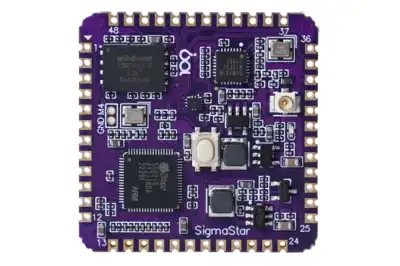
The DongshanPI-PicoW is a tiny Linux-based board with a dual-core 1GHz CPU, 64MB of RAM, 128MB of flash, and WiFi connectivity for $7.
For several years now, I’ve been saying that the future of microcontrollers is probably Linux. As processor power increases, it’s inevitable that solutions like Arduino or even the ESP32 will be relegated.
A good example is that, for some time now, various Linux boards have appeared. They have in common that they have few resources (compared to, for example, a Raspberry Pi), run lightweight versions of Linux, are very small in size, and have a very low price.
The DongshanPI-PicoW is a good example of this trend. It incorporates a dual-core Cortex-A7 processor at 1GHz SigmaStar SSD210, with 64MB of RAM. For storage, it has 128MB NAND SPI.
These are limited resources, but enough to run a lightweight version of Linux. And quite impressive, considering it has a size of 31 x 31 mm.
The DongshanPI-PicoW has wireless connectivity thanks to the inclusion of an SSW101B chip that provides 2.4GHz 802.11b/g/n WiFi.
The board’s perimeter is surrounded by four rows of holes, for a total of 48. Programming and connection must be done through these pins, as there are no ports or connectors on the PCB.
{ “CPU and Memory”: [ { “label”: “Processor”, “value”: [“SigmaStar SSD210 dual-core”, “Arm Cortex-A7 @1.0GHz”, “(FPU, NEON, MMU, DMA, 2D accelerator)”] }, { “label”: “RAM”, “value”: “64MB on-chip DDR2” }, { “label”: “Storage”, “value”: “128MB NAND SPI Flash (Winbond W25N010)” } ], “Connectivity”: [ { “label”: “WiFi”, “value”: “4 Sigmastart SSW101B 802.11b/g/n 2.4GHz” }, { “label”: “Ethernet”, “value”: “1x 10/100M” }, { “label”: “USB”, “value”: “2-port switch Onsemi FSUSB30” }, { “label”: “Programming”, “value”: “DongShanPi-PicoW USB debug” } ], “Devices”: [ { “label”: “Headers”, “value”: “Four 12-pin 2.0mm pitch” }, { “label”: “Interfaces”, “value”: [“1x SDIO 2.0”, “2x SPI”, “2x I2C”, “4x UART”, “4x PWM”, “GPIOs”] }, { “label”: “Display”, “value”: “TTL output up to 1280x800 60fps” }, { “label”: “Audio”, “value”: “MIC and DMIC inputs, line output, I2S/TDM 8-channel Rx 2/4/8” } ], “Power and Dimensions”: [ { “label”: “Power”, “value”: “5V via I/O pins” }, { “label”: “Dimensions”, “value”: “31 x 31 mm (estimated)” } ] }
However, don’t be fooled. It’s a tough board to use. Don’t expect anything like a Raspberry Pi. Getting this board to work is going to be a bit of a nightmare.
Specifically, the DongShanPi-PicoW does not have any ports or connectors installed. Programming and connection must be done through the available pins. Frankly, I think a reusable carrier board to facilitate programming would be a great addition to the package.
As is often the case with these types of boards, documentation is scarce. In this case, part of it is exclusively in Chinese, so you’ll have to rely on Google Translator.
For programming and flashing, a specific tool from the manufacturer is used. A Linux image is also provided. More information on the product page https://dongshanpi.com/DongshanPi-PicoW/01-BoardIntroduction/
The DongShanPi-PicoW is very interesting for advanced projects, where you really need a mini (very mini!) Linux computer, such as robotics and IoT applications.
The board is sold on Aliexpress for €7 plus shipping (around €10 total). But keep in mind that to program it you will need, at the very least, an external TTL converter.