It is essential, before conducting an energy audit, to understand the specific consumption of each particular use and, more specifically, what portion of the building’s total consumption is represented by the different installations. This way, we can focus energy-saving measures on the largest energy consumers, dedicating most of the effort and investment to them.
In this post, we will address the energy consumption that occurs in residential buildings. Below, we include a chart showing the percentage of total consumption represented by each installation.
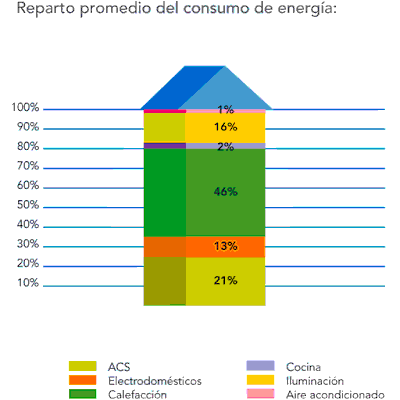
From the image, the following conclusions can be drawn:
- The largest energy expenditure, by far, is heating, accounting for 46% of the building’s total consumption. For this reason, special attention must be paid in energy audits to the climate control system, temperature control, ventilation, and the building’s thermal envelope.
- 67% of a home’s energy is used for direct heat generation (heating 46% and hot water 21%). It is therefore crucial to review the proper functioning of heat generators, such as boilers and heat pumps.
- Lighting accounts for 16% of the building’s total energy consumption, and more than half of the electricity bill. Using high-efficiency lamps, control mechanisms like occupancy sensors, and proper utilization of natural light can lead to significant savings on the electricity bill.
- Appliances consume 13% of total energy, and about one-third of the electricity used in homes. Among them, the largest consumers are refrigerators, ceramic hobs, and washing machines. In contrast, computers, televisions, dishwashers, and microwaves have lower consumption. It is advisable to purchase high-efficiency appliances, especially for the three mentioned above.
These values represent a good indicator for the general case and as a starting point. However, it should be noted that these are indicative statistical values, obtained from the average of a large number of homes. Therefore, it is necessary for a specialized technician to analyze each specific building.