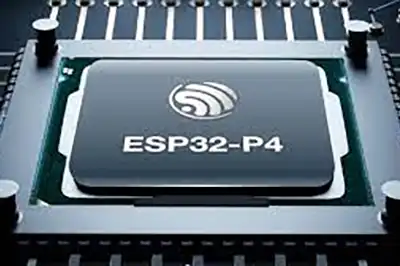
The ESP32-P4 is a system on a chip (SoC) developed by Espressif Systems that stands out for its immense power, number of connections, and security features.
This powerful SoC is powered by a dual-core RISC-V processor up to 400MHz which also features floating-point (FPU) and artificial intelligence (AI) extensions.
Furthermore, the ESP32-P4 incorporates a 40MHz LP (low power) core. This processor is used in low-power consumption applications, while the HP cores are reserved for tasks requiring high computing power.
In other words, we have an extremely powerful processor for what is usual in embedded and IoT processors. Which, additionally, also allows it to operate in scenarios where energy efficiency is vital.
Regarding memory, the ESP32-P4 integrates 768KB of SRAM on-chip with the possibility of adding more external PSRAM. It also has 8KB of zero-wait TCM RAM, which can be used as a high-speed buffer.
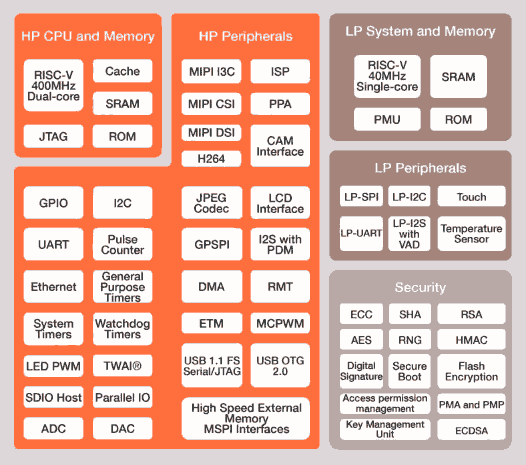
In terms of connections, the ESP32-P4 is a monster with over 50 programmable GPIOs. It supports all commonly used peripherals, such as SPI, I2S, I2C, LED PWM, MCPWM, RMT, ADC, DAC, UART, and TWAITM.
The ESP32-P4 also has support for high-speed connectivity via USB OTG 2.0 HS, Ethernet, and SDIO Host 3.0., and support for MIPI-CSI and MIPI-DSI, for connecting displays or cameras.
It also includes capacitive touch inputs, voice recognition functions, even support for H.264 video encoding, and PPA (Pixel Processing Accelerator) acceleration for GUI development. Basically, they’ve put everything on this beast 😮.
Regarding security features, as mentioned at the beginning, it’s one of the focal points for Espressif in designing the ESP32-P4. This SoC features advanced security characteristics, such as Secure Boot, Flash encryption, cryptographic accelerators, TRNG, Digital Signature Peripheral, and Key Management Unit.
As a more negative point, unlike most members of the ESP32 range, the ESP32-P4 lacks wireless connectivity. Instead, the manufacturer recommends connecting it with another ESP32-C/S/H series chip via SPI/SDIO/UART.
As we can see, the ESP32-P4 is a powerhouse of a processor primarily intended for Edge Computing and AI applications in IoT. It is an extremely powerful SoC that is also suitable for low-power applications.
The lack of wireless connectivity takes away several points. But, I suppose, as devices and boards that mount it appear, it will be common to see it in a Dual configuration alongside another ESP32 (we’ll have to see how well that works out).
References: