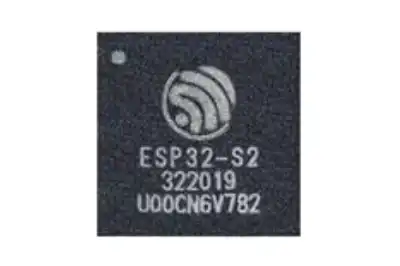
The ESP32-S2 SoC is a high-performance microcontroller developed by Espressif Systems, specifically designed for Internet of Things (IoT) applications.
The ESP32-S2 is one of the variants in the ESP32 family. In short, the ESP32-S2 is a variant with a single core and without Bluetooth, suitable for low-power and low-cost applications.
The ESP32-S2 is equipped with a single-core Xtensa LX7 RISC-V processor, which operates at speeds up to 240 MHz. It also features a Floating Point Unit (FPU) for precise and accelerated mathematical calculations.
This processor architecture provides an optimal balance between performance and power consumption, making it an efficient choice for IoT applications with low-power requirements.
The ESP32-S2 SoC offers flexible memory and storage options. It has 320 KB of internal SRAM and supports the use of external memory via SPI or QSPI interfaces.
Regarding flash storage, the ESP32-S2 SoC offers up to 128 MB of flash memory, allowing for the storage of firmware, data, and additional application files.
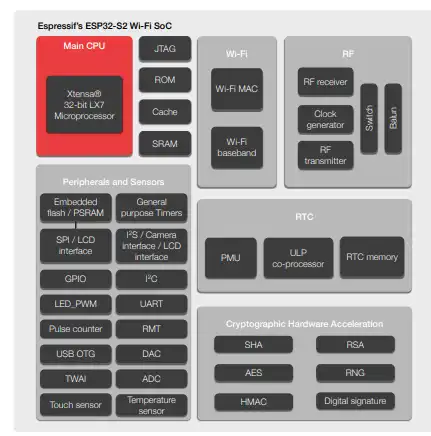
Regarding connectivity, the ESP32-S2 maintains the characteristic Wi-Fi of the ESP32 series. It supports the 802.11b/g/n Wi-Fi standard, ensuring a stable and reliable connection.
However, as mentioned earlier, the ESP32-S2 lacks Bluetooth. Keep this in mind if you choose this particular model, so you don’t get an unpleasant surprise.
Regarding peripherals, the ESP32-S2 features a wide range of interfaces. These include UART, SPI, I2C, I2S, and PWM, enabling communication with sensors, displays, actuators, and other devices.
Additionally, it also includes a 12-bit ADC for precise analog signal conversion and an 8-bit DAC.
Regarding security, the ESP32-S2 includes a variety of advanced features, such as support for AES cryptography, SSL/TLS, and RSA, ensuring the protection of transmitted data. It also includes a hardware Random Number Generator (RNG) for generating secure cryptographic keys and values.
{ “CPU and Memory”: [ { “label”: “CPU”, “value”: [“Xtensa® single-core 32-bit LX7 microprocessor, up to 240 MHz”, “External memory: SPI/QSPI/OSPI supports multiple flash and external RAM chips”] }, { “label”: “Memory”, “value”: “128 KB ROM, 320 KB SRAM, 16 KB RTC SRAM” } ], “Peripherals”: [ { “label”: “GPIO”, “value”: “43” }, { “label”: “ADC/DAC”, “value”: [“2 × 13-bit SAR ADCs (20 channels)”, “2 × 8-bit DACs” ] }, { “label”: “Touch Sensing”, “value”: “14 IOs” }, { “label”: “Interfaces”, “value”: “4 SPI, 1 I2S, 2 I2C, 2 UART, RMT TX/RX” }, { “label”: “PWM”, “value”: “LED PWM up to 8 channels” }, { “label”: “USB”, “value”: “1 full-speed OTG” }, { “label”: “Sensors”, “value”: “Temperature” } ], “Wi-Fi”: [ { “label”: “Standard”, “value”: “IEEE 802.11 b/g/n-compliant” }, { “label”: “Bandwidth”, “value”: “20 MHz, 40 MHz in 2.4 GHz” } ], “Security”: [ { “label”: “Features”, “value”: [“Secure Boot”, “Flash Encryption”, “AES-128/192/256, RSA, RNG, HMAC, Digital signature”] } ] }