If you are a technology enthusiast, you probably know the ESP32, a low-cost, high-performance microcontroller that has become very popular in the world of robotics, IoT, and prototyping electronics. On our blog, we have frequently talked about the ESP32, presented different boards, and dedicated a specific section to it.
However, as new versions are released, it is becoming increasingly difficult to keep up with the features and differences of each model.
This is further complicated when we consider that Espressif, the company that develops the ESP32, uses designations that are not particularly clear to identify its products.
Furthermore, it is common for people to confuse the terms processor, SoC (System on a Chip), SoM (System on a Module), and development board. This is especially problematic in the case of the ESP32, as its product range includes all four typologies.
To help compare and differentiate between the various ESP32 models, Espressif provides us with a series of comparison tools. With these tools, we can see the differences between each model and choose the one that best suits our needs.
Summary Comparison Table
One of them is this simple table where we can verify the differences in technical characteristics of its most popular models (ESP32, ESP32-S2, ESP32-S3, and ESP-C3), which we can find in its full version at this link
{ “models”: [ { “name”: “ESP32”, “color”: “#f43f5e” }, { “name”: “ESP32-S2”, “color”: “#d946ef” }, { “name”: “ESP32-C3”, “color”: “#06b6d4” }, { “name”: “ESP32-S3”, “color”: “#10b981” } ], “categories”: { “General”: [“Launch year”, “Core”, “Wi-Fi protocols”, “Bluetooth®”, “Typical frequency”, “Voltage Range”], “Memoria”: [“SRAM”, “ROM”, “External flash”, “External RAM”], “Periféricos”: [“ADC”, “DAC”, “Timers”, “Touch sensor”, “GPIO”, “SPI”, “UART”, “I2C”, “I2S”, “Ethernet MAC”, “CAN Bus (TWAI)”, “Hall Sensor”, “Temp. Sensor”], “Energía”: [“Deep Sleep”], “Seguridad”: [“Secure Boot”, “Flash Encryption”, “RNG”] }, “specs”: { “Launch year”: [“2016”, “2020”, “2020”, “2020”], “Core”: [“Xtensa® Dual LX6”, “Xtensa® Single LX7”, “RISC-V Single”, “Xtensa® Dual LX7”], “Wi-Fi protocols”: [“b/g/n”, “b/g/n”, “b/g/n”, “b/g/n”], “Bluetooth®”: [“v4.2 + BLE”, ”❌”, “5.0 + BLE”, “5.0 + BLE”], “Typical frequency”: [ { “val”: 240, “max”: 240, “unit”: “MHz” }, { “val”: 240, “max”: 240, “unit”: “MHz” }, { “val”: 160, “max”: 240, “unit”: “MHz” }, { “val”: 240, “max”: 240, “unit”: “MHz” } ], “Voltage Range”: [“2.2 ~ 3.6V”, “2.8 ~ 3.6V”, “3.0 ~ 3.6V”, “3.0 ~ 3.6V”], “SRAM”: [ { “val”: 520, “max”: 520, “unit”: “KB” }, { “val”: 320, “max”: 520, “unit”: “KB” }, { “val”: 400, “max”: 520, “unit”: “KB” }, { “val”: 512, “max”: 520, “unit”: “KB” } ], “ROM”: [ { “val”: 448, “max”: 448, “unit”: “KB” }, { “val”: 128, “max”: 448, “unit”: “KB” }, { “val”: 384, “max”: 448, “unit”: “KB” }, { “val”: 384, “max”: 448, “unit”: “KB” } ], “External flash”: [“Up to 16 MB”, “Up to 1 GB”, “Up to 16 MB”, “Up to 1 GB”], “External RAM”: [“Up to 8 MB”, “Up to 1 GB”, ”❌”, “Up to 1 GB”], “ADC”: [“2x 12-bit”, “2x 12-bit”, “2x 12-bit”, “2x 12-bit”], “DAC”: [“2x 8-bit”, “2x 8-bit”, ”❌”, ”❌”], “Timers”: [“4x 64-bit”, “4x 64-bit”, “2x 54-bit”, “4x 54-bit”], “Touch sensor”: [ { “val”: 10, “max”: 14 }, { “val”: 14, “max”: 14 }, ”❌”, { “val”: 14, “max”: 14 } ], “GPIO”: [ { “val”: 34, “max”: 45 }, { “val”: 43, “max”: 45 }, { “val”: 22, “max”: 45 }, { “val”: 45, “max”: 45 } ], “SPI”: [“4”, “4”, “3”, “4”], “UART”: [“3”, “2”, “2”, “3”], “I2C”: [“2”, “2”, “1”, “2”], “I2S”: [“2”, “1”, “1”, “2”], “Ethernet MAC”: [“10/100 Mbps”, ”❌”, ”❌”, ”❌”], “CAN Bus (TWAI)”: [“1”, “1”, “1”, “1”], “Hall Sensor”: [“✔️”, ”❌”, ”❌”, ”❌”], “Temp. Sensor”: [“✔️”, “✔️”, “✔️”, “✔️”], “Deep Sleep”: [“~10 µA”, “~20 µA”, “~5 µA”, “~7 µA”], “Secure Boot”: [“✔️”, “✔️”, “✔️”, “✔️”], “Flash Encryption”: [“✔️”, “✔️”, “✔️”, “✔️”], “RNG”: [“✔️”, “✔️”, “✔️”, “✔️”] } }
Espressif Comparison Tool
On the other hand, Espressif’s main tool for comparing ESP32 model versions is the product selection webpage available at this link.
In it, we can choose from a dropdown menu among all ESP32 models, being able to select both SoC and SoM products.
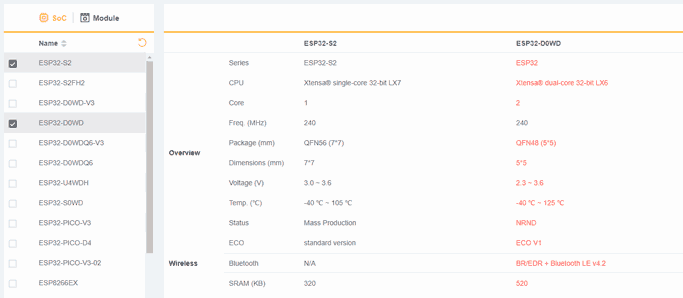
In the results table, we have the main technical characteristics of each model, which include the processor model, RAM, GPIO, ADC, communication buses, among many others.
Thanks to these Espressif tools, we can easily determine the similarities and differences between the different ESP32 models.