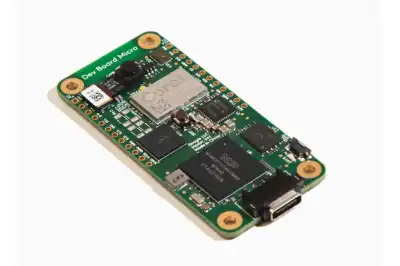
The Coral Dev Board Micro is a development board created by Google, as part of its devices for artificial intelligence and edge computing.
This board is a more compact and low-power version than its predecessors, the original Coral Dev Board and the Coral Dev Board Mini, and is designed to provide developers with an accessible tool for creating edge AI solutions.
The Coral Dev Board Micro is designed to be used in edge AI solutions, such as in IoT devices, robots, and security systems. With its Edge TPU coprocessor, the board can run AI models in real-time with extremely low power consumption.
The Coral Dev Board Micro uses an NXP i.MX RT1176 Cortex-M7/M4 processor and a Google Coral Edge TPU coprocessor, accompanied by 128MB of flash memory and 64 MB of RAM.
Furthermore, the board includes a 324x324px camera and a microphone, making it very suitable for vision and audio applications. For example, we could use it for a voice recognition system project or to analyze images in real-time.
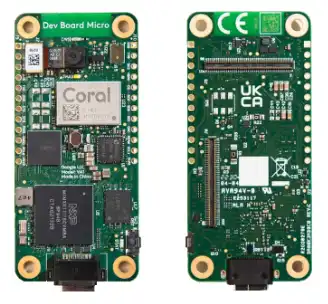
{ “CPU and Memory”: [ { “label”: “Processor”, “value”: “NXP i.MX RT1176 with 2 Arm Cortex-M7 and Cortex-M4 cores” }, { “label”: “Coprocessor”, “value”: “Coral Edge TPU (2 TOPS / Watt)” }, { “label”: “Memory”, “value”: [“128 MB flash”, “64 MB RAM”, “2 MB SRAM”] } ], “Connectivity”: [ { “label”: “USB”, “value”: “1x Type-C 2.0 port” }, { “label”: “WiFi”, “value”: “5 optional” }, { “label”: “Bluetooth”, “value”: “5.0 optional” } ], “Devices”: [ { “label”: “Camera”, “value”: “Himax 324 x 324 px” }, { “label”: “Microphone”, “value”: “PDM mono” }, { “label”: “GPIO Connectors”, “value”: “2x 12-pin” }, { “label”: “Board-to-board connectors”, “value”: “2x 100-pin” }, { “label”: “LEDs”, “value”: “4” }, { “label”: “Buttons”, “value”: “2” } ], “Dimensions”: [ { “label”: “Dimensions”, “value”: “65 x 30 mm” } ] }
The Coral Dev Board Micro is really small, especially when compared to the rest of the Coral family. At 65x30 mm, it has a size similar to a Raspberry Pi Zero.
Regarding connections, it has 2 rows of 12 pins for GPIO, 4 LEDs, and two buttons. In addition to a 100-pin connector (!) intended for connecting multiple boards together. For power and programming, we have a USB-C port.
Regarding software and programming, the board comes standard with FreeRTOS, being the recommended way to program the Coral Dev Board Micro. However, it is also possible to program it with the Arduino environment.
Finally, regarding AI capabilities, the Coral Dev Board Micro is compatible with TensorFlow Lite for Microcontrollers (TFLM). Furthermore, Google provides extensive documentation and tutorial guides to help developers get started using the board.
The Coral Dev Board Micro is not yet available, but it is possible to pre-order it with a pre-sale price of $79.99. More information and all documentation on the product page at https://coral.ai/docs/dev-board-micro/get-started/.