
We are starting this home automation course, where we will see how to set up a centralized, robust, and professional smart system in our own home.
As it must be, in this first article we are going to lay the foundations before we start installing servers, flashing devices, or running cables through the walls of your house.
More importantly, we need to understand the current landscape and, above all, why the model sold to us by manufacturers doesn’t work for us (basically, it’s broken by design).
Throughout the course, we will see how to fix this mess by setting up our own system with different tools, like Home Assistant.
But first, we must understand the problem we are facing 👇.
What is Home Automation Really?
In a home automation course, the first thing is to define what home automation is. Traditionally, we define it as the set of systems capable of automating a home.

However, the term has been distorted. I will be very clear: remote control is not home automation (just like a remote-control car is not a robot).
Turning on a light bulb or lowering a blind from a mobile phone is useful (maybe even flashy)… but it’s still just a glorified switch.
A home is intelligent when the system makes decisions for us based on the state of its environment.
For example: turning on the hallway light at 20% brightness only if it’s nighttime, motion is detected, and the living room TV is off.
To achieve this level of interaction, we need the devices to talk to each other. This is where we clash with the mess we mentioned, the reality of the market 👇.
The Problem of a Thousand Manufacturers
The problem is that every manufacturer that launches a plug, a light bulb, or a sensor on the market does so with the intention of locking us into their own App.
If we buy a Philips light bulb, we have to use their application. If we buy a TP-Link plug, we use another. If we add a Xiaomi sensor, we need a third one.
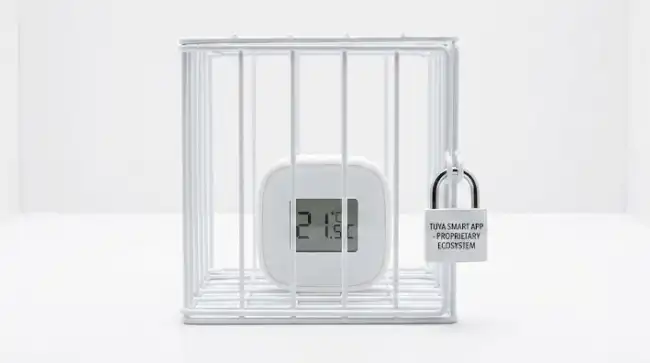
This creates two huge problems:
Incompatibility between devices: Brand A’s motion sensor cannot communicate directly with Brand B’s light bulb.
Absolute dependence on the manufacturer: We are at the mercy of the official app. If the app is bad, has bugs, or stops receiving updates, our device becomes useless.
This deliberate fragmentation means you either have to marry a single brand forever, or have your phone full of apps that don’t talk to each other.
The Goal of the Course: Unification
If commercial home automation offers us cheap devices, but isolated, cloud-dependent, and only compatible with the manufacturer.
Our goal is to liberate those devices and unify them under a single local brain that we control.
Throughout this course, we will learn how to do this, for example, by deploying a Home Assistant server that will act as a universal translator.
We will teach it to speak with commercial devices, eliminate their dependence on the cloud whenever possible, and create a network where all our gadgets talk and live happily together.
In the next post, we will go into detail about the main providers and commercial ecosystems that dominate the market (like Tuya, eWeLink, and the big tech companies), to understand exactly what we are buying when we acquire low-cost hardware.
