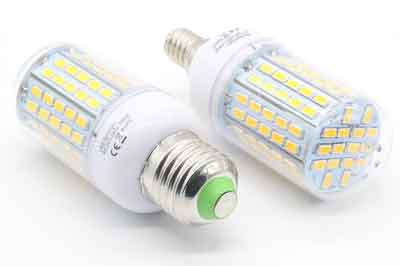
If you look for LED bulbs from international Chinese sellers on AliExpress, eBay, or similar, you will find a variety of very cheap LED bulbs that integrate the SMD 5730 LED.
This family of LED bulbs consists of a “cluster” with a variable number of SMD 5730 LEDs. The dimensions and characteristics of the bulb depend on the number of LEDs mounted. Prices range from €1.20 to €1.70 depending on power.
We find models with E27 or E14 bases. Although it has no effect on the technical characteristics of the bulb, logically we will have to purchase the appropriate bulb for our fixture.
However, the technical specifications given by Chinese sellers are quite unreliable (to put it mildly). So we have many doubts about these bulbs.
Are these bulbs really efficient? Are we wasting our money? Is it better to buy an LED bulb from a known manufacturer? We can even ask: Are compact fluorescent bulbs better? Is it worth replacing them?
And with so many questions, I felt like conducting a test to really check if these very cheap bulbs are worth it, or if their characteristics and efficiency are so poor that they are not worth buying.
So in this post, we are going to compare different models of Chinese SMD 5730 LED bulbs against different types of incandescent and compact fluorescent (CFL) bulbs.
SMD 5730 LED
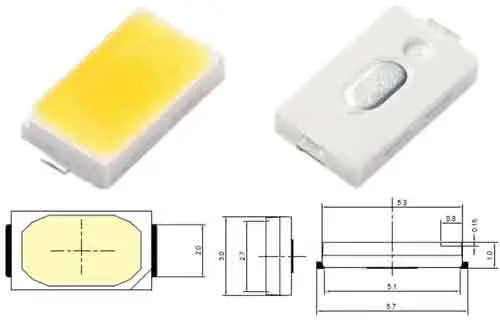
First, let’s look at the technical characteristics of the SMD 5730, extracted from its DataSheet.
| Dimensions | 5.7 x 3.0 x 1.0 mm |
|---|---|
| Supply Voltage | 3.1-4V |
| Maximum Current | 150mA |
| Luminous Flux | 35-55 lm |
| Power | 0.53W |
| Angle | 120º |
Test Parameters
Although this test is completely homemade, to make it at least useful we will try to give it some rigor, within the technical means at my disposal. Therefore, first, we will present the test parameters.
Bulbs Tested
For the test, we have several models of SMD 5730 LED bulbs that I bought for the test, with different numbers of LEDs and all in white.
For comparison, we have various types of incandescent and compact fluorescent bulbs. Basically, everything I could find at home, and that wasn’t too old to avoid degradation in performance.
Logically, we already know that incandescent bulbs are going to give very poor results. But they serve as a reference for comparison or “control pattern.” After all, bulb manufacturers themselves always compare efficiency with the incandescent equivalent, not among themselves.
The comparison with compact fluorescent bulbs is going to be much more interesting. In theory, the luminous efficiency results should be on the order of magnitude of an LED bulb. Compared to a quality LED bulb, it is foreseeable that the CFL will lose, but what about against these cheap SMD 5730 LED bulbs?
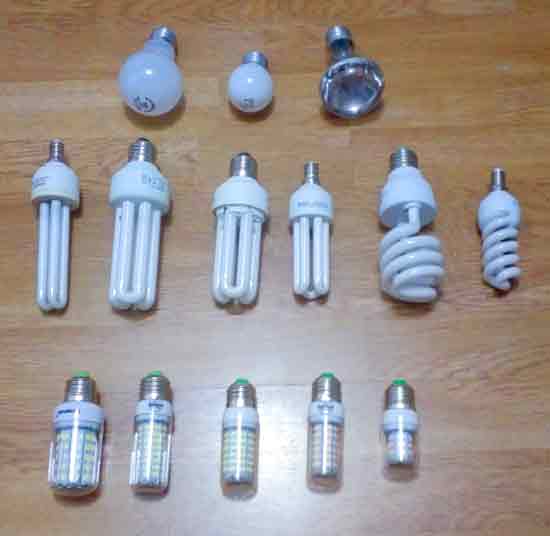
The bulbs we are going to test are, from top to bottom, and left to right.
Incandescent
- 60W Spherical Incandescent Bulb
- 40W Spherical Incandescent Bulb
- 60W Spot Incandescent Bulb
Compact Fluorescent
- 15W Double Tube CFL Bulb
- 21W Triple Tube CFL Bulb
- 20W Triple Tube CFL Bulb
- 11W Triple Tube CFL Bulb
- 22W Spiral CFL Bulb
- 20W Spiral CFL Bulb
SMD 5730 LED Bulb
- 108 SMD LED Bulb (11W?)
- 80 SMD LED Bulb (9W?)
- 69 SMD LED Bulb (7W?)
- 48 SMD LED Bulb (5W?)
- 24 SMD LED Bulb (3W?)
The nominal power data for the Incandescent and compact fluorescent bulbs are printed on the bulb itself, so there is no doubt here regarding the manufacturer’s specifications.
However, the Chinese SMD 5730 LED bulbs have no power reference either on the bulb or on the box. The only reference we have is on the sellers’ pages, and we see many discrepancies.
The powers listed above (that’s why they appear between ??) are the most “reasonable” ones from the several ads we have seen. But we also find that other sellers put much higher powers for the same bulbs (see next image). We will discuss this later.
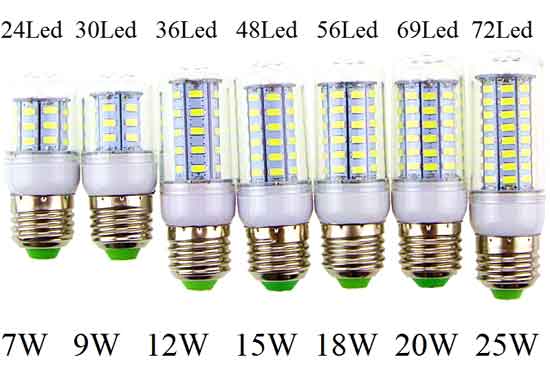
On the other hand, it must be said that the 24SMD, 48SMD, and 69SMD bulbs are from one seller, and the 80SMD and 108SMD from another. Externally they seem from the same range, but I cannot guarantee that internally they are identical.
Electrical Measurement
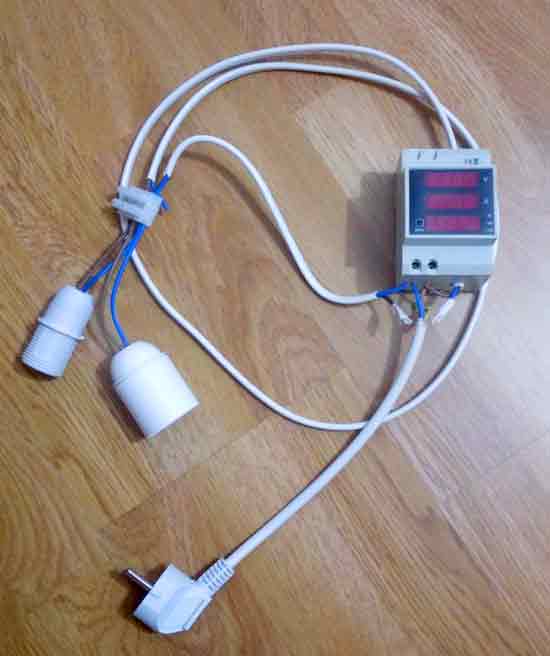
For the electrical measurement, I will use a KETOTEK electrical power meter, a device normally installed on a DIN rail that allows measuring electrical current, voltage, real and apparent power, and the cosine of Phi.
For the measurement, I have attached two E14 and E27 bases, because I have bulbs with both types of bases. The base should be totally independent of the bulb’s behavior.
The setup looks like this.
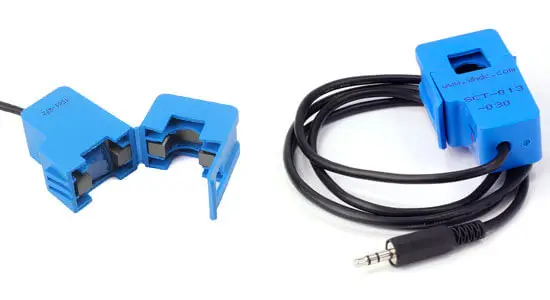
On the other hand, I am going to use a non-invasive current sensor SCT-013 connected with an Arduino. The reason is that I want to have a second measurement of electrical consumption, since the power meter is not designed for such small loads. And, on the other hand, because I want to take the opportunity to check the accuracy of the SCT-013.
Luminosity Measurement
For a characterization of the bulbs we should measure the lumens emitted by the bulb. Unfortunately, I don’t have an integrating sphere in my living room, so we will have to settle for measuring lux.
Therefore, the lighting measurements are not going to be absolute but quantitative. That is, they will serve us to compare the bulbs among themselves, but the numerical value itself has no physical meaning beyond this test.
For the measurement, I placed two chairs with a crossbar on them. In the middle of the wooden crossbar, I have a hook, which I will use to place the bulbs always at the same point. The distance from the bottom end of the base to the floor is 700mm.
During bulb changes we will keep the base position fixed. Since the bulbs have different lengths, the luminous center of the bulb will vary relative to the sensor.
Keeping the base, instead of the center of the bulb, has been done this way because, in reality, when changing a bulb, what we keep fixed is the base or the fixture. However, in reality, the distance is also usually greater than 700mm, so the effect of the bulb length may have less influence than in this test.
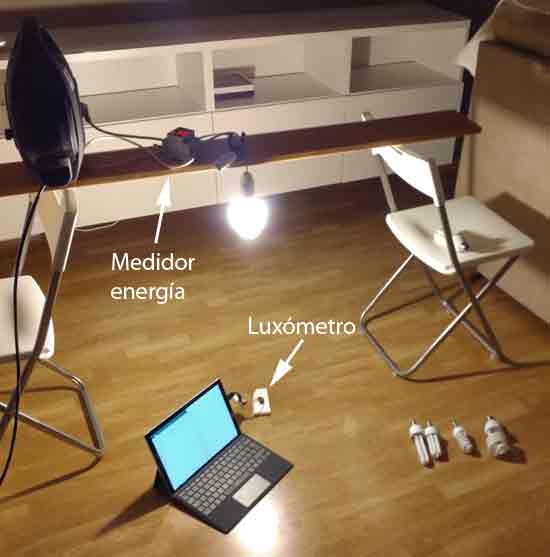
The test was done at night and in the absence of any other light source. On the other hand, the bulbs are away from walls and ceiling, so that light reflections from the environment have minimal influence, and the luxes we measure characterize the bulb as well as possible, and not the room.
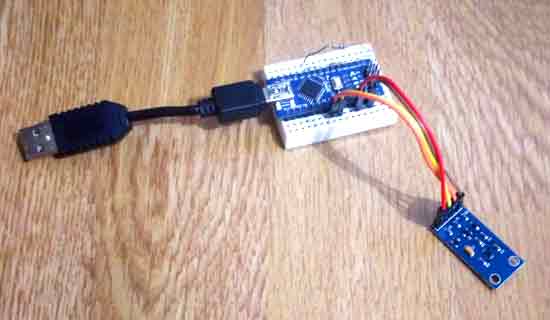
As a lux meter, I will use a BH1750 connected to Arduino and a computer.
On the other hand, since the bulbs have different distributions depending on the angle, I am going to take the measurement at 0º (front to the bulb) and at 90º (sideways to the bulb).
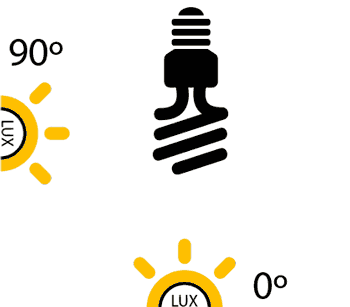
To avoid moving the lux meter and changing its position, first we will take all measurements at 0º and then at 90º. This way we can keep the sensor fixed during each series of measurements.
- In the 0º location, the sensor is simply placed on the floor
- In the 90º location, the sensor is attached to one of the chairs.
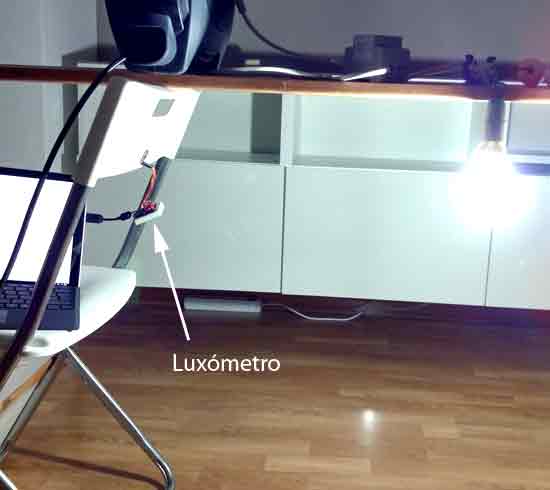
In both orientations, I have tried to keep the distance to the lux meter at 700mm. However, given the change in conditions (sensor location and its surroundings), it will not be entirely correct to compare the lux values at 0º and 90º. Nevertheless, I repeat that I have tried to be as precise as possible, so they are comparable.
Each setup is recorded for 10 min and the final measurement value is the average of the last 20 seconds of the measurement. This was done because fluorescent bulbs increase their luminosity over time, until reaching a stable value. In contrast, LED bulbs slightly decrease their luminosity over time, due to the increase in temperature.
However, it is possible that after 10 min the CFL bulbs could still increase their value further. In any case, after 10 minutes the observed value remained stable. Although it is possible that in continuous operation for several hours CFLs would increase their luminosity level more, I consider that,
- The remaining increase should be quite small.
- The possible “penalty” does not seem too unfair, given that we often turn on the light for less than 10 minutes. If it takes you 2 hours to reach nominal lighting, you “deserve” to be penalized a little.
- I can’t test eight bulbs for several hours, at two different angles, because… I need to use my living room and I have a life and stuff.
Results
Incandescent Bulbs
As we said, incandescent bulbs will be our “control pattern.” We already know that incandescent bulbs are inefficient and we should not use them, but they will serve us to compare with the rest.
These are the electrical measurements,
| Bulb | Nominal | VA | W | CosPhi | SCT013 |
|---|---|---|---|---|---|
| Spherical | 40W | 36 | 36 | 1.00 | 36 |
| Spherical | 60W | 56 | 56 | 1.00 | 54 |
| Spot | 60W | 54 | 54 | 1.00 | 52.8 |
We see that the cosine of Phi is 1. Therefore, the apparent power (VA) and the active power (W) coincide. On the other hand, the measured values are quite close to the nominal powers marked by the manufacturer.
Finally, the measurement with the STC-013 also approximates quite well to that recorded by the power meter.
Regarding lighting, here are the values,
| Bulb | Nominal | Luxes 0º | Luxes 90º |
|---|---|---|---|
| Spherical | 40W | 92.00 | 122.00 |
| Spherical | 60W | 147.00 | 206.00 |
| Spot | 60W | 1200.00 | 43.00 |
In spherical bulbs, the luxes at 0º and 90º are of the same order of magnitude, while in the Spot type, logically, most of the light is directed forward.
Regarding efficiency, the following results.
| Bulb | Nominal | Lux0º/W | Lux90º/W |
|---|---|---|---|
| Spherical | 40W | 2.56 | 3.39 |
| Spherical | 60W | 2.63 | 3.68 |
| Spot | 60W | 22.22 | 0.80 |
These values will be taken as reference to compare with CFL and SMD 5730 LED bulbs.
But I repeat again that the Luxes/W measurements are quantitative magnitudes, valid for comparison in this test. But outside the test (or if we modify any element of the setup) the number ceases to have meaning.
Beyond the measurements, the bulbs heat up to the point of burning to the touch within seconds of being connected. What a waste of energy!
Compact Fluorescent Bulbs
Next, we have the electrical measurements for the compact fluorescent bulbs.
| Bulb | Nominal | VA | W | CosPhi | SCT013 |
|---|---|---|---|---|---|
| 3 tubes | 21W | 29 | 14 | 0.52 | 16.4 |
| 3 tubes | 20W | 23 | 11 | 0.50 | 13 |
| 3 tubes | 11W | 15 | 6 | 0.40 | 8.2 |
| 2 tubes | 15W | 23 | 11 | 0.48 | 13.7 |
| Spiral | 20W | 15 | 7 | 0.47 | 9.8 |
| Spiral | 22W | 22 | 11 | 0.50 | 12.5 |
It’s quite interesting. First, and curiously, the bulbs do not meet the manufacturer’s nominal power specifications by any chance, even though they are bulbs from recognized brands (these are not Chinese!). I expected more rigor regarding the nominal value.
On the other hand, and as expected, we have a very low cosine of phi, around 0.5. This causes the absorbed active power (W) to be about half the apparent power (VA).
For its part, the STC-013 seems to have deviations from the active power. The measurement I get is somewhat higher. In principle, I would say that the cosine of phi is causing the deviation. I note it as a point to consider in future calibrations of the STC-013.
Regarding lighting, these are the recorded values,
| Bulb | Nominal | Luxes 0º | Luxes 90º |
|---|---|---|---|
| 3 tubes | 21W | 140 | 394 |
| 3 tubes | 20W | 135 | 323 |
| 3 tubes | 11W | 70 | 198 |
| 2 tubes | 15W | 59 | 215 |
| Spiral | 20W | 82 | 147 |
| Spiral | 22W | 143 | 157 |
Which in terms of efficiency become the following,
| Bulb | Nominal | Lux0º/VA | Lux90º/VA | %(VA)/incand |
|---|---|---|---|---|
| 3 tubes | 21W | 4.83 | 13.59 | 388% |
| 3 tubes | 20W | 5.87 | 14.04 | 401% |
| 3 tubes | 11W | 4.67 | 13.20 | 377% |
| 2 tubes | 15W | 2.57 | 9.35 | 267% |
| Spiral | 20W | 5.47 | 9.80 | 280% |
| Spiral | 22W | 6.50 | 7.14 | 204% |
And now comes a very interesting part. Regarding apparent power, compact fluorescent bulbs are between 2-4 times more efficient than incandescent ones.
However, most domestic users (unlike industrial consumers) pay for active power (W) and not for apparent power (VA), as long as we don’t exceed a power factor of 0.9, at which point they start charging us a surcharge for reactive consumption.
Regarding active power, the efficiency is 4-9 times that of an incandescent bulb.
| Bulb | Nominal | Lux0º/W | Lux90º/W | %(W)/incan. |
|---|---|---|---|---|
| 3 tubes | 21W | 10.00 | 28.14 | 804% |
| 3 tubes | 20W | 12.27 | 29.36 | 839% |
| 3 tubes | 11W | 11.67 | 33.00 | 943% |
| 2 tubes | 15W | 5.36 | 19.55 | 558% |
| Spiral | 20W | 11.71 | 21.00 | 600% |
| Spiral | 22W | 13.00 | 14.27 | 408% |
That is, the fact that the bulb is consuming reactive energy, for practical purposes for us, is “improving” the efficiency of the bulb, because a domestic consumer does not pay for VA but for W.
With this we are not saying that consuming a little reactive energy is good. In fact, we should have the installation compensated for an electrical “hygiene” issue.
But the truth is that, in this case, it is cheaper for us because the power in W is half that in VA. (as long as we don’t reach the 0.9 penalty, which shouldn’t happen if the only uncompensated inductive loads we have are a reasonable amount of compact fluorescent bulbs).
SMD 5730 LED Bulbs
Finally, we come to the SMD5730 bulbs. These are the electrical measurements,
| Bulb | Nominal | W | VA | CosPhi | SCT013 |
|---|---|---|---|---|---|
| 24 smd | 3W | 6 | 6 | 0.00 | 7 |
| 48 smd | 5W |