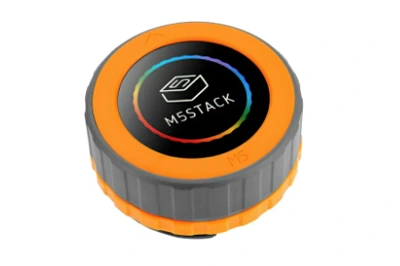
The M5Dial is a new device from our favorite manufacturer, M5Stack, which features a 1.28” round screen along with a rotary encoder, all housed in its casing.
Lately, we’ve seen the emergence of a series of devices clearly inspired by the Google Nest. And let’s face it, round screens have a certain “je ne sais quoi,” but they’re cool.
In this case, the M5Dial is M5Stack’s version, which, as usual, comes to show us how to make a product right, both in features and in appearance, quality, and finish.
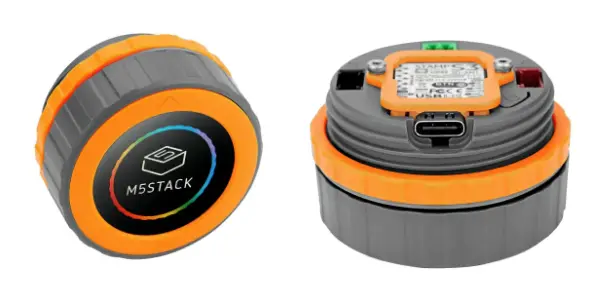
This time, the manufacturer has decided to include an M5StampS3 as the “brain” of the M5Dial, which comes included with the product.
This has the enormous advantage that we can easily remove the M5StampS3, either for programming or even to reuse it across multiple projects. In my opinion, this seems like a smart and very clever option.
The M5StampS3 is powered by the king of SoCs at the moment, our beloved ESP32-S3. It stands out for its high performance and low energy consumption, making it ideal for smart control applications.
In terms of features, we find the Xtensa® dual-core 32-bit LX7 microprocessor, @240 MHz, with 384 KB ROM, 512 KB SRAM, 8MB PSRAM, 8 MB Flash. It also features Wi-Fi 802.11 b/g/n and Bluetooth 5.
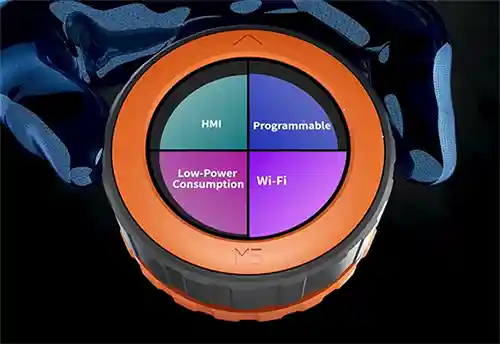
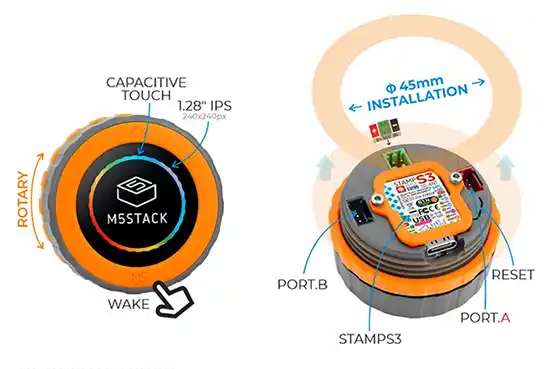
One of the most notable features of the M5Dial is its 1.28-inch round TFT touch screen, with 240x240px. For its control, we find the well-known GC9A01 driver and an FT3267 for the touch functionality.
On the other hand, the M5Dial includes a 360º rotary encoder that precisely records the position and direction of the rotating knob. This allows for more intuitive, precise, and different interaction than usual for your projects.
For example, we can use the rotary encoder to adjust settings like volume, brightness, and menu options, or to control devices in your smart home, such as lights, air conditioning, and curtains.
The device also incorporates an RFID detection module operating at 13.56MHz. We can use it for reading RFID cards and tags, for example, for access control applications, identity verification, or even payment systems.
{ “CPU and Memory”: [ { “label”: “SoC”, “value”: “Espressif Systems ESP32-S3FN8” }, { “label”: “CPU”, “value”: “Xtensa® dual-core 32-bit LX7 @240 MHz” }, { “label”: “Memory”, “value”: [“384 KB ROM”, “512 KB SRAM”, “8MB PSRAM”, “8 MB Flash”] }, { “label”: “Included Module”, “value”: “M5StampS3” } ], “Devices”: [ { “label”: “Screen”, “value”: “Round TFT 1.28 in. 240x240px GC9A01 touch FT3267” }, { “label”: “Encoder”, “value”: “360º rotary in casing” }, { “label”: “RFID Sensor”, “value”: “WS1850S 13.56MHz” }, { “label”: “Expansion”, “value”: “PORT-A (I2C/UART) and PORT-B (GPIO) ports” } ], “Power and Dimensions”: [ { “label”: “Power Supply”, “value”: “6-36V DC” }, { “label”: “Consumption”, “value”: [“DC6V/140.6mA”, “DC12V/82.5mA”, “DC36V/28.1mA”] }, { “label”: “Dimensions”, “value”: “45x45x32.3 mm” }, { “label”: “Weight”, “value”: “46.6 g” } ] }
For device connectivity, the M5Dial exposes two connection ports. PORT-A (G14 SCL and G13 SDA) is intended for I2C or UART communication, and PORT-B (G2 OUT and G1 IN) for use as GPIO.
Regarding power, the M5Dial is compatible with 6-36V DC inputs and has a lithium battery charging interface and circuit for portable use. This allows for a wide range of options to power the device, including the possibility of using a 2S or 3S lithium battery.
As if that weren’t enough, the M5Dial features a built-in RTC (Real-Time Clock) circuit, a physical button on the casing, and an integrated buzzer. It’s got everything.
For mounting, the M5Dial can be inserted into a 45mm hole, for example, in wood or drywall. To do this, the end part of the casing is threaded, and a part of the casing itself acts as a “nut” to secure the assembly.
Programming is done directly via the USB-C port and is compatible with the Arduino environment, PlatformIO, and M5Stack’s visual programming platform, UI Flow.
The selling price is around $35 dollars. Which, in my opinion, is a very good price for a device with these features. As usual with M5Stack, the finish of the device, the documentation, and even the packaging are excellent. A true example for other manufacturers to follow.
The M5Dial is an impressive device that combines the powerful ESP32-S3, a round touch screen, and a rotary encoder in a compact package full of “extra” accessories. It is focused on home automation, access control, and industrial control systems. But I can easily imagine a lot of projects where it would fit.
Without a doubt, if you want a device with a round screen, whether to test in your projects or to install in a real application, the M5Dial seems to me one of the most interesting options available.
References: