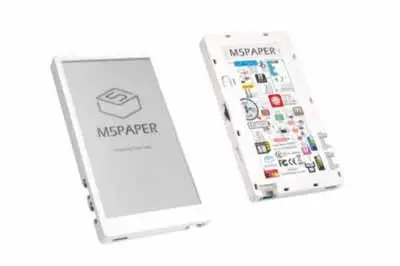
We’re back with an entry about the M5Stack family (which we saw in this post) to look at a relatively recent member, the M5Paper. A device that stands out for its e-ink touchscreen.
The M5Paper mounts an ESP32-D0WDQ6-V3 processor with 16MB Flash and 8MB of PSRAM. The rest of the features are those we already know from the ESP32, which we summarize as a 2-core processor up to 240Mhz, with WiFi and BT connectivity.
But the most notable feature is the inclusion of a 960x540 pixel e-ink display, with 16 shades of gray, and a capacitive GT911 multi-touch (2-point) screen. It supports partial update and a refresh rate of up to 200ms.
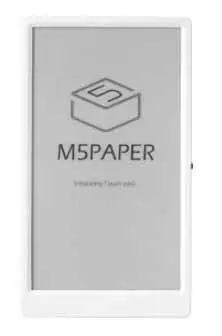 Electronic ink brings the benefits of visibility and low power consumption. However, the manufacturer recommends not using the screen for prolonged periods under UV sources (meaning it is not suitable for outdoor use).
The package is completed with a 1150mAh battery, an RTC BM8563, an SHT30 temperature and humidity sensor, magnets to fix the M5Paper to a metal surface, and a side button in the form of a “scroll wheel” that allows action in two directions + press.
As we can see, it’s a very interesting device. To mention a couple of ‘buts’, the side button sometimes behaves a bit erratically and on (few) occasions does not correctly detect the press.
Another minor inconvenience is that there is no easy way to tell if the device is on. Due to its way of functioning, an e-ink screen retains the last displayed view. You can’t imagine how annoying it is not to know what power state it’s in. A small LED connected to a GPIO would solve this problem.
Except for these small opportunities for improvement (and, while we’re at it, a 9-axis IMU) the M5Paper is a very interesting device with many possibilities. Besides, let’s not deny it, electronic ink displays have something special.
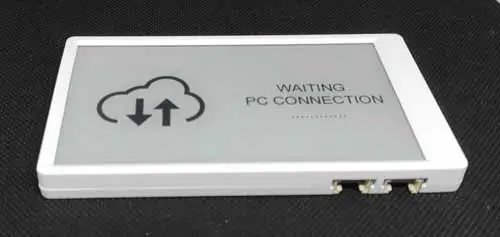
The number of possible applications is enormous, from a remote control for home automation applications, remote signage, IoT and Industry 4.0 applications. In short, a whole little toy worth taking a look at.