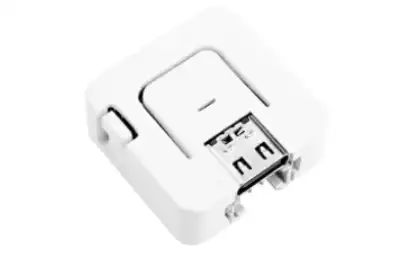
M5Stack has launched a new IoT control device called the AtomS3 Lite, a very interesting device for our home automation, robotics, and DIY projects.
The AtomS3 Lite is part of the Atom family, being the younger sibling of the AtomS3 we saw in this post about the M5Stack Atom S3. Compared to it, it presents itself as a device with fewer features, but a much lower price.
Like the rest of the devices in the Atom family, the new AtomS3 Lite is based on the powerful ESP32-S3. Specifically, it features an ESP32-S3FN8 SoC, a dual-core 32-bit processor at 240MHz.
Regarding memory, the AtomS3 Lite proves not to be so “lite” and boasts the usual 512KB SRAM and 8MB PSRAM of the family, more than enough memory for most projects we want to tackle.
Like other processors based on an ESP32, the AtomS3 Lite features wireless WiFi and Bluetooth connectivity, allowing it to connect to the internet and other devices using these protocols.
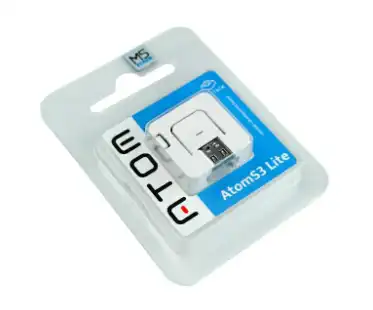
The main difference compared to the AtomS3 is that the AtomS3 Lite does away with the TFT screen and the IMU sensor found in its bigger brother. Instead, it incorporates an RGB LED that can be used to provide visual indicators to users.
Another distinctive feature is that the AtomS3 Lite has an infrared transmitter that can be used to control electronic devices that have an IR remote control, such as TVs, air conditioners, etc.
Regarding connections, we find 9 pins on the back, 6 GPIOs (G5, G6, G7, G8, G38, and G39) and 3 power pins (5V, 3.3V, and GND). It also has a Grove expansion connector for connecting I2C devices.
The AtomS3 Lite also features a USB-C port for power and programming. In addition to a reset button, and a user function button, located under the RGB LED itself.
We cannot forget to mention another distinctive feature of the Atom family, which is its small size and weight. With dimensions of only 24x25x9.5mm and a weight of 5.3 grams, it is a device we can comfortably carry even in a pocket.
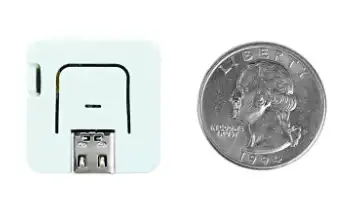
{ “CPU and Memory”: [ { “label”: “MCU”, “value”: [“Espressif Systems ESP32-S3FN8”, “Dual-core 32-bit Xtensa LX7 @240MHz” ]}, { “label”: “Memory”, “value”: “512KB SRAM and 8MB PSRAM” } ], “Connectivity”: [ { “label”: “WiFi”, “value”: “2.4 GHz, 802.11 b/g/n” }, { “label”: “Bluetooth”, “value”: “5 (BLE)” }, { “label”: “USB”, “value”: “Type-C” } ], “Devices”: [ { “label”: “GPIO Pins”, “value”: “9x (G5, G6, G7, G8, G38, G39, 5V, 3.3V, GND)” }, { “label”: “Grove Connector”, “value”: “4-pin” }, { “label”: “LEDs”, “value”: [“Infrared”, “RGB WS2812B-2020”] }, { “label”: “Buttons”, “value”: “Reset and user” }, { “label”: “Mounting”, “value”: “M2 hole” }, { “label”: “Converter”, “value”: “CSY8089 from 5V to 3V3” } ], “Dimensions and Weight”: [ { “label”: “Dimensions”, “value”: “24 x 24 x 9.5 mm” }, { “label”: “Weight”, “value”: “5.3 grams” } ] }
The AtomS3 Lite is compatible with the Arduino programming language, with MicroPython, and with the UIFlow platform, M5Stack’s visual programming tool.
Regarding price, it is currently sold on the M5Stack page for $7.5. That’s less than half the price of its bigger brother, the M5Atom S3, which sells for €15.5. It’s really a competitive price for a device with these features.
Furthermore, having the infrared LED makes it interesting as an IoT controller for the smart home. For example, to control devices that have an infrared remote, via WiFi or Bluetooth.
As we can see, it is a very interesting option if we don’t need the TFT screen or the IMU of the M5Atom S3. It’s a compact and lightweight device, with very good finish (as usual with M5Stack), and with the added benefit of having IR control.