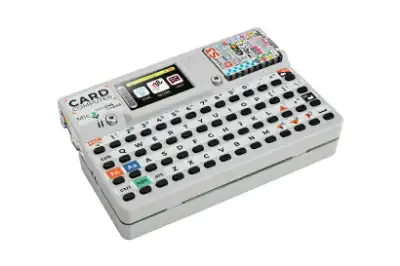
Cardputer is the new device from M5Stack. With an ESP32-S3, TFT screen, keyboard, and barely the size of a card, this device aims to be your pocket computer.
Of course, we can’t think of it as a “conventional” computer (with Linux or Windows). But the Cardputer is a highly portable, programmable device packed with features and extras.
The Cardputer is powered by the M5StampS3 development board, which is included in the product. This board, in turn, houses an ESP32-S3.
The decision to rely on the M5StampS3 seems like a great move to me, as I mentioned a few days ago when looking at the M5Dial, because we can easily remove the M5StampS3, for example to swap it between projects.
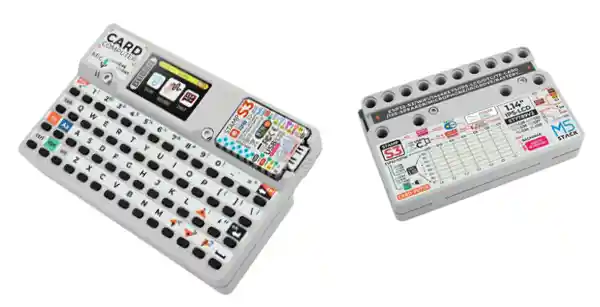
Regarding the ESP32-S3, an old acquaintance of the blog, it is the latest version of Espressif’s popular processor and one of the most advanced and versatile SoCs (System on a Chip) on the market.
This powerful SoC features a dual-core Xtensa® 32-bit processor running at 240 MHz, accompanied by 384 KB of ROM, 512 KB of SRAM, 8 MB of PSRAM, and 8 MB of Flash memory.
Furthermore, the ESP32-S3 provides the Cardputer with 802.11 b/g/n Wi-Fi and Bluetooth 5 connectivity, making it perfect for wireless communication tasks.
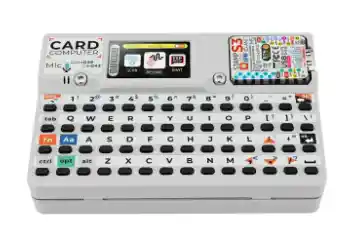
Regarding the standout features of the Cardputer, the first thing we find is its 56-key keyboard, arranged in 4 rows of 14 buttons. Despite its small size, the buttons are comfortable to use and emit a pleasant “click” when pressed.
The keyboard layout is English. So, my Spanish-speaking friends, forget about our peculiar Ñ. It was to be expected in this type of device, but we’ll still miss you “meños” (oh my, what a joke).
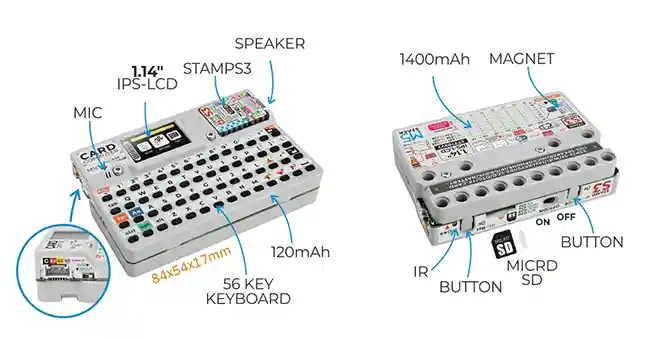
At the top of the device, we find a 1.14-inch LCD screen with a resolution of 240x135 pixels, driven by the ST7789V controller. We find the same configuration, for example, in the popular M5Stick-C Plus.
Regarding audio, the Cardputer is equipped with an integrated SPH1423 microphone and a 1W speaker with an NS4148 amplifier. So we can both capture sound and generate our own sounds or notifications.
For data storage, the Cardputer includes a microSD card reader that allows expanding the storage capacity to meet our project’s needs.
Additionally, the Cardputer incorporates two lithium batteries. A smaller 120 mAh one, and a 1400mAh one in the lower casing. In Stand-By mode, the device consumes 0.26uA, so we should have plenty of autonomy.
In terms of connectivity, we only find a Groove connector, which we can use for I2C or UART. With this, we can connect sensors or additional peripherals to expand its capabilities.
Furthermore, we have an infrared LED for remote control applications, and a power on/off button.
{ “CPU and Memory”: [ { “label”: “SoC”, “value”: “Espressif Systems ESP32-S3FN8” }, { “label”: “CPU”, “value”: “Xtensa® dual-core 32-bit LX7 @240 MHz” }, { “label”: “Memory”, “value”: [“384 KB ROM”, “512 KB SRAM”, “8MB PSRAM”, “8 MB Flash”] }, { “label”: “Included Module”, “value”: “M5StampS3” } ], “Devices”: [ { “label”: “Screen”, “value”: “TFT 1.14 in. 240x135 ST7789V” }, { “label”: “Keyboard”, “value”: “56 keys (4x14)” }, { “label”: “Audio”, “value”: “MEMS Microphone, 1W Speaker” }, { “label”: “Storage”, “value”: “micro-SD Card” }, { “label”: “Infrared LED”, “value”: “Yes” }, { “label”: “Expansion”, “value”: “Groove Port (I2C/UART)” } ], “Power and Dimensions”: [ { “label”: “Battery”, “value”: “120mAh + 1400mAh” }, { “label”: “Dimensions”, “value”: “85x54x71 mm” } ] }
One of M5Stack’s distinctive characteristics is the quality of its casings. In this case, it doesn’t disappoint, and we find a robust and compact plastic enclosure, joined with screws.
It also includes magnets to facilitate assembly and mounting on various surfaces. We also find a striking strip of holes, designed to be compatible with Lego. Which I think is a very smart and, in a way, endearing detail.
All this in an impressive and compact size of only 85x54x71mm. That is, a small marvel of engineering. I find it amazing how M5Stack manages to create devices with this set of technical features in such a small space.
Overall, I can say that the Cardputer lives up to the expectation of being a “pocket computer.” It is an All-in-One multipurpose device with an ESP32-S3, keyboard, and screen, plus IR LED, MicroSD, microphone, and speaker.
Whether for IoT projects, smart control, simply to enjoy technology, or just for playing, the Cardputer presents itself as a true sweet treat for electronics enthusiasts.
References: