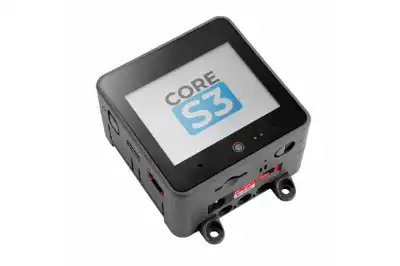
M5Stack has today launched the third generation of its Core family development kits, called Core S3. A new version that stands out for the large number of peripherals it incorporates.
Traditionally, the Core series is the flagship of the manufacturer M5Stack, intended for DIY applications, IoT project development, industrial automation, and home automation.
This time, the renewed Core S3 model comes with a dual-core Xtensa LX7 ESP32-S3 processor, running at 240MHz. This is accompanied by 512 KB of SRAM memory, 16MB of Flash, and 8MB of PSRAM.
Regarding connectivity, the ESP32-S3 provides the usual 2.4 GHz wireless connection, WiFi 802.11 b/g/n, and Bluetooth 5 (BLE). Something we are already accustomed to in Espressif’s processor family.
One of the strongest points of the Core series has always been the integration of multiple peripherals into a single device. In the M5Stack, they have taken this philosophy to another level.
The CoreS3 has a 2.0-inch IPS display with a resolution of 320x240 pixels, a durable glass panel, and a capacitive touch panel. Similar in characteristics to the one found in the previous Core 2 model.
Furthermore, it features a 480x640 pixel (0.3 MPx) GC0308 camera and an LTR-553ALS-WA proximity sensor. Both are new within the Core series and can be very useful when integrated into our projects.
Regarding sound, it has a high-fidelity 16-bit I2S amplifier AW88298 and a 1W speaker integrated into the casing. For sound input, it uses a dual microphone along with an ES7210 audio encoding chip.
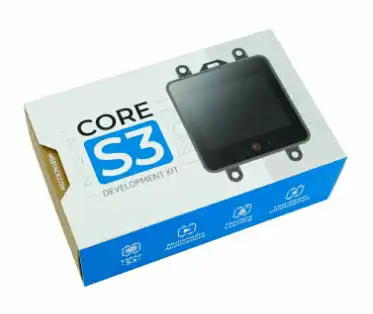
The internal IMU has also been improved, now being a 6-axis BMI270 sensor. They have added a BMM150 magnetometer to this, a very important improvement (and one I was looking forward to) for making robots.
The M5Stack Core S3 also features a BM8563 real-time clock to provide precise time measurement and a sleep timer alarm function.
The internal battery has been expanded to 500mA. On the other hand, it comes by default with a DIN rail mounting base, which incorporates a power connector compatible with voltages from 9V to 24V.
Furthermore, the CoreS3 uses an AXP2101 power management integrated circuit and a 4-way power flow control circuit, making it suitable for applications where low power consumption is required.
It also has a TF (microSD) card slot, a TYPE-C port for downloading programs, and supports OTG and CDC functions to facilitate connection with external USB devices.
And honestly, I’ve lost count of how many times I’ve used “furthermore” and “also” in this article, because as you can see, the new Core S3 is packed with peripherals. They’ve put everything in it.
{ “CPU and Memory”: [ { “label”: “MCU”, “value”: [“Espressif Systems ESP32-S3”, “Dual-Core 32-bit Xtensa LX7 @240MHz”] }, { “label”: “Memory”, “value”: “512KB SRAM and 8MB PSRAM” }, { “label”: “Flash”, “value”: “16MB” } ], “Connectivity”: [ { “label”: “WiFi”, “value”: “2.4 GHz, 802.11 b/g/n” }, { “label”: “Bluetooth”, “value”: “5 (BLE)” } ], “Devices”: [ { “label”: “Display”, “value”: “Touch IPS 2.0 in. @320x240” }, { “label”: “Touch Panel”, “value”: “Capacitive ILI9342C” }, { “label”: “Camera”, “value”: “480x640px GC0308” }, { “label”: “Sensors”, “value”: [“Proximity LTR-553ALS-WA”, “6-axis IMU BMI270 + magnetometer BMM150”] }, { “label”: “Audio”, “value”: [“1W Speaker with AW88298 amplifier”, “Dual microphone with ES7210 chip”] }, { “label”: “RTC”, “value”: “BM8563” }, { “label”: “Power Management”, “value”: “AXP2101 Chip” } ], “Dimensions and Weight”: [ { “label”: “Dimensions”, “value”: “54 x 54 x 16 mm” }, { “label”: “Weight”, “value”: “73.3g” } ] }
The M5Stack Core S3 goes on sale for $60. Which, personally, I think is a very good price considering the specifications it has and the huge number of peripherals it incorporates.
More information about the new M5Stack model, as well as product documentation, on the manufacturer’s website https://docs.m5stack.com/en/core/CoreS3