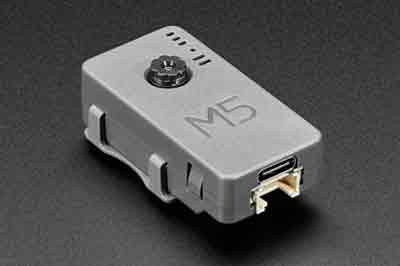
Today we are going to look at another device from the M5Stack family, the Timer Camera X, a device based on the ESP32 that incorporates a 3-megapixel OV3660 camera.
The Timer Camera X is the enhanced, souped-up, and tuned version by M5Stack of the well-known ESP32 + Camera modules, which we already saw in ESP32 + Camera Module, How to Make Web Videostream. Therefore, the possibilities we will get, from a functional point of view, are similar to an ESP32 module with a camera.
The main point and the advantage that the Timer Camera X provides is the ease of use, thanks to its differentiating features such as its compact body, integrated battery and RTC, or programming directly via USB-C.
Analyzing the whole, inside we find our well-known ESP32 from the manufacturer Espressif with 8M-PSRAM. Its features are well-known, and we summarize them as a 32-bit processor with 2 cores up to 240Mhz, WiFi and BT connectivity.
On the other hand, the camera is an OV3660 from the manufacturer Omnivision (OVT). The resolutions available in the OV2640 model are QVGA (320 x 240), CIF (352 x 288), VGA (640 x 480), SVGA (800 x 600), XGA (1024 x 768), SXGA (1280 x 1024) and UXGA (1600 x 1200) and QXGA (2048 x 1536).
The M5Stack Timer Camera X is available with two lenses. A “normal” one, with a DFOV of 66.5º, and one with a wide angle (or fisheye) with a DFOV of 120º. In both cases, the dimensions are 48x24x15mm, and the weight is 15g.
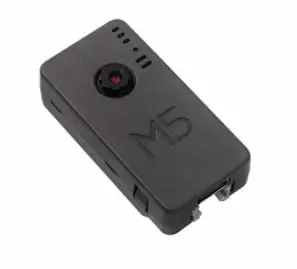
Getting into the advantages compared to a normal EPS32 + Camera module, first, we find that the M5Stack Timer Camera X comes in a compact plastic case. The quality, as we are used to from the manufacturer, is appreciable at first glance.
On the other hand, another advantage of the set is that it incorporates an internal 140mAh battery. The set is completed with a BM8563 RTC, which allows waking up the Timer Camera X at regular intervals, an indicator LED, and a reset button.
The combination of battery and RTC is one of the distinctive features of the Timer Camera X, and which give the device its name. The design of the Timer Camera X is designed to minimize consumption, being only 2uA in Deep Sleep mode. This translates into the fact that taking a photo every hour, the Timer Camera X can run for more than a month on the integrated battery.
Although it is capable of video streaming, we recall that any ESP32 and camera module is not intended for continuous use, according to Espressif’s own recommendations.
Finally, the last advantage of the M5Stack Timer Camera X is that we can program it directly from a USB Type C. This represents an improvement over a traditional ESP32 + Camera module, which require connecting an additional external converter.
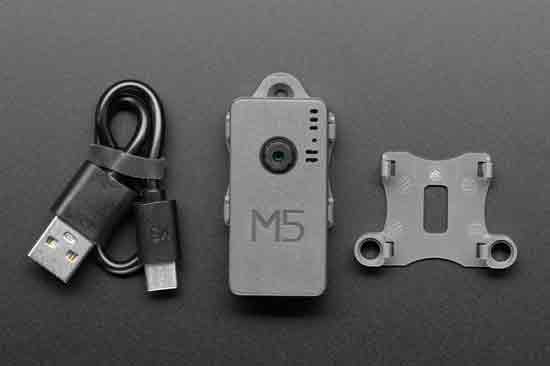
Regarding presentation and packaging, M5Stack once again demonstrates why it is becoming one of the favorite brands in the sector. The device is delivered in a plastic box, which includes a USB-C cable, two mounts.
One of the mounts is for attaching the Timer Camera X to a servo, while the other is compatible with Lego. This shows M5Stack’s attention to detail, and how they are perfect experts on the audience they are targeting.
These advantages, logically, have a cost. This translates into the price of the M5Stack being 15€, quite higher than that of an ESP32 + Camera module, but it is justified by the advantages we have over them.
Finally, the product is well documented on the product’s website, where there is a quick start guide. Also, we have the code repository on GitHub with some examples. Although most of the code available for any ESP32 + Camera module should be compatible.
In short, if you want to do tests with the ESP32 + Camera, the M5Stack is not the cheapest option, but it is probably the most comfortable one. Personally, I see it as an advanced and “User-Friendly” version of an ESP32 + Camera.
Of course, it does not (nor do I think it intends to) replace the much cheaper standard modules. But it is a very interesting device to comfortably perform tests, mount it on a robot, make a prototype. In short, to play and enjoy it.
Afterwards, if desired, it would be easy to port the code to a cheaper module, probably making a specific case for it. In this way, we can recover the M5Stack Timer Camera X to use it in other projects.
It is also interesting in projects where we can take advantage of its case, battery, and RTC. The first case that comes to mind is a surveillance camera, to take photos periodically. Personally, I don’t find this to be its most interesting use. But I do see it attached to a robot, or a robotic arm, for example, or in a bunch of other projects.
In short, in my opinion the Timer Camera X is a very interesting device that joins the many other members of the M5Stack family, which we are liking more and more for the design, manufacturing, and documentation of their products.