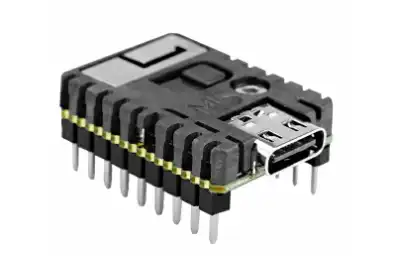
The M5StampS3 is a development board from the manufacturer M5Stack, which stands out for both its technical features and its compact size.
The M5StampS3 joins the rest of the M5Stamp family members. Among others, we find the original M5Stamp with ESP32 (non-S3) and the M5StampC3.
All models in the M5Stamp range are distinguished by their features in a truly small footprint. However, with the M5StampS3, they have simply raised the bar to another level.
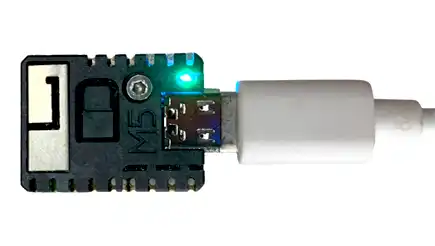
As its name suggests, the M5StampS3 is powered by the Espressif ESP32-S3 SoC. Specifically, we find an ESP32-S3FN8 SoC, which integrates a Xtensa® Dual-Core 32-bit LX7 processor of up to 240 MHz.
This SoC provides us with 384 KB ROM, 512 KB SRAM. But, in addition, the M5StampS3 comes with 8MB of flash memory, more than enough for the vast majority of projects.
This means the M5StampS3 is capable of handling intensive processing tasks with ease. Whether you need to process sensor data or run complex algorithms, this embedded controller is up to the task.
Regarding wireless connectivity, the ESP32-S3 provides the M5StampS3 with 2.4 GHz 802.11 b/g/n WiFi and Bluetooth 5 with speeds up to 125 MB/s.
The M5StampS3 is designed to be “the brain” of our projects and other devices. So expandability is paramount. Here the M5StampS3 shows off, and exposes an impressive number of 23 GPIOs.
Considering its dimensions, this number is incredible. However, given its small size, to access all of them we will need to use a 1.75mm header. If we use the usual 2.54mm pitch instead, not all pins will be available.
On the other hand, all pins are Castellated. That is, they reach to the edge of the board. This allows it to be integrated into PCB Carrier boards, either permanently soldered or via some kind of press-fit socket.
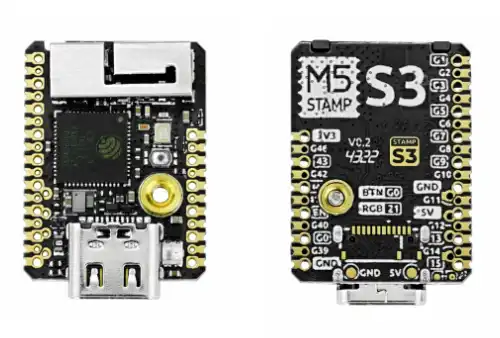
Here is a summary of its main features:
{ “CPU and Memory”: [ { “label”: “SoC”, “value”: “Espressif Systems ESP32-S3FN8” }, { “label”: “CPU”, “value”: “Xtensa® dual-core 32-bit LX7 @240 MHz” }, { “label”: “Memory”, “value”: [“384 KB ROM”, “512 KB SRAM”, “8 MB Flash”] } ], “Connectivity”: [ { “label”: “WiFi”, “value”: “2.4 GHz 802.11 b/g/n up to 150 Mbps” }, { “label”: “Bluetooth”, “value”: “5, Mesh, 125 Kbps-2 Mbps” }, { “label”: “Antenna”, “value”: “3D 2.4 GHz” } ], “Peripherals”: [ { “label”: “GPIOs”, “value”: “23 (G0-G15, G39-G46)” }, { “label”: “Interfaces”, “value”: [“UART”, “I2C”, “I2S”, “SPI”, “Pulse Counter”, “PWM”] }, { “label”: “Headers”, “value”: “2.54 mm and 1.27 mm” }, { “label”: “Holes”, “value”: “Castellated for PCB” }, { “label”: “Storage”, “value”: “SD/SDIO/MMC” }, { “label”: “Touch Sensor”, “value”: “Yes” }, { “label”: “FPC Connector”, “value”: “8 or 12 pin GPIO/LCD” }, { “label”: “Button”, “value”: “User” }, { “label”: “LED”, “value”: “RGB WS2812B-2020” }, { “label”: “USB”, “value”: “Type C power/programming” } ], “Power and Dimensions”: [ { “label”: “Power”, “value”: “5V @500mA USB-C, DC/DC 5V-3.3V” }, { “label”: “Dimensions”, “value”: “26 x 18 x 5 mm” }, { “label”: “Weight”, “value”: “3.2 g” }, { “label”: “Temperature”, “value”: “0-40°C” } ] }
For power, the M5StampS3 incorporates an MUN3CAD01-SC integrated circuit that reliably converts 5V to 3.3V. This means you can count on your device running smoothly without interruptions due to voltage fluctuations.
It also has a UART converter, so programming and Serial communication is as easy as connecting via USB-C. A great advantage over the first M5Stamp, which needed an external programmer.
As if that weren’t enough, they still managed to equip it with a programmable button and an RGB WS2812B LED. We can use them, for example, as user input and status indicator.
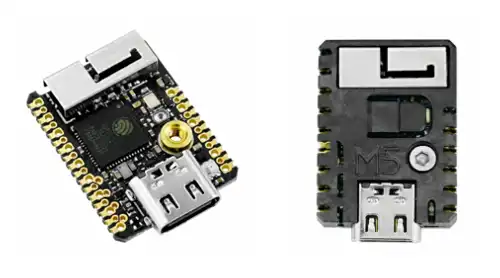
Finally, the set is completed with a flame-retardant case and an allen mounting screw. All this in a size of 26 x 18 x 5 mm and only 3.2 grams. It’s incredible.
Of course, it is fully compatible with the usual programming options, such as the Arduino IDE, PlatformIO, as well as the M5Stack UI Flow graphical environment.
The M5StampS3 is on sale for a price of $7.50. A price somewhat higher than other development boards, but which in my opinion is justified by its impressive technical features and size.
In fact, the M5StampS3 series seems to me one of the best options available for including an ESP32 in our projects. Especially if they are going to be integrated into a PCB we make ourselves.
References: