We continue with the 3D printing section with this entry about 3D printing materials.
In previous posts, we have seen how an FFF 3D printer works, its parts and components, and we have looked in detail at the printhead, the hotend, and the extruder.
Now that we have seen the FFF printer and its operation in detail, it’s time to move on, and the next step is to talk about the materials we are going to use for 3D printing.
Of course, there is a wide variety of filaments and materials, and if we start looking at comparisons we could end up dizzy and with little clarity.
So let’s make it easy. Your favorite materials for home printing are going to be PLA and PETG. They are your workhorses, your all-terrain vehicles.
Wait, did you mean PLA and ABS? No, PLA and PETG. We will talk about the popular ABS at the end of this entry, but, despite what you may have heard, currently ABS is not such a good option for 3D printing, with PETG as its substitute.
At the end of the entry, we will also see other more “exotic” materials, less common and more difficult to print.
Of course, most materials are available in a wide variety of colors. In principle, the color does not (almost) affect the material’s properties. There are also semi-transparent ones, which change color with temperature or under sunlight.
PLA
PLA (Polylactic Acid) is a plant-based derivative, often from corn and sugarcane. Without a doubt, PLA is the undisputed king of filament 3D printing and the most common in home printing.
PLA is easy to print, requires low temperature, and barely needs a heated bed (although it is convenient). The extrusion temperature is 190-220 °C, with a bed temperature of 45-60°C.
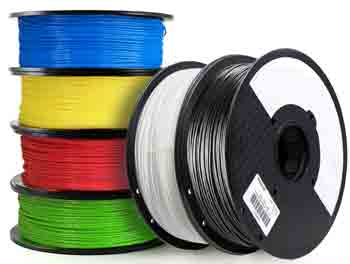
It has good bed adhesion and does not present warping during printing. It also does not emit toxic fumes or odors. Furthermore, it is an ecological and biodegradable plastic.
Regarding mechanical characteristics, PLA is considerably strong, hard, although somewhat more brittle than other plastics. That is, it withstands stress quite well, is difficult to scratch, but handles impacts worse.
The biggest disadvantage of PLA is that, given its low melting point, it does not support parts subjected to thermal loads. PLA parts deform at temperatures above 60°C.
Furthermore, it cannot be used outdoors because it degrades under the sun’s ultraviolet rays. It also cannot be used to contain food. Finally, it is not resistant to water or chemicals.
The cost of a one-kilogram spool is around €16-24, depending on the manufacturer.
PETG
PETG (Glycol Polyethylene Terephthalate) is a variation of PET, a plastic widely used in the food industry to make containers like bottles.
PETG is a very easy material to 3D print, as easy as PLA. The extrusion temperature is 230-250 °C, with a bed temperature of 55-75°C. It has good bed adhesion and hardly causes problems with warping during printing. It also does not emit toxic fumes or odors.
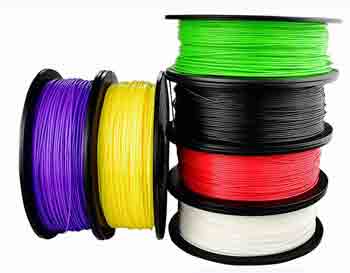
Mechanically, PETG has very good properties, even superior to the famous ABS. Compared to PLA, it is less strong, softer, but tougher. That is, it possibly withstands lower stresses, scratches more easily, but handles impacts better.
It should also be noted that parts printed in PETG achieve excellent layer adhesion, which substantially favors their good mechanical behavior.
Unlike PLA, parts made from PETG are safe for contact with food. They also have better temperature resistance and can be used in outdoor applications. Furthermore, it is hardly flammable.
As a problem, PETG is a very hygroscopic material. If the material absorbs moisture from the environment, it can cause difficulties when printing. Therefore, when not using the spool, it is advisable to store it in an airtight container.
As we can see, it is an all-terrain material very suitable for 3D printing. The price is slightly higher than PLA, around €20-28.
Other Materials
Although we have presented PLA and PETG as our two favorite filaments, we couldn’t talk about 3D printing materials without reviewing, even quickly, some of the other materials.
In general, they all have their advantages and disadvantages. But they are certainly more difficult to print, due to warping, adhesion problems, or requiring very high temperatures.
Use these materials only when you know
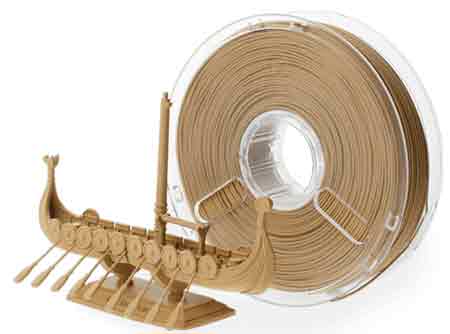
PLA Wood
It is a PLA to which a certain content of wood chips is added. It gives a very good appearance. The parts can be sanded to improve the finish.
It prints the same as PLA, but has a great tendency to cause clogs in the hotend.
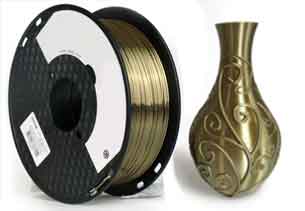
PLA Metal
It is a PLA to which a certain metal content is added. The parts, when printed, are matte. But after sanding, they become shiny and with a very bright appearance.
It also prints the same as PLA, but those metal particles can cause wear on the hotend.
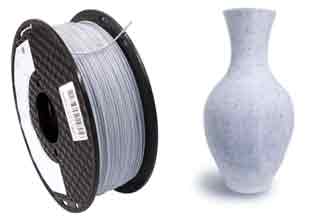
PLA Marble
It is a white PLA that alternates black specks. The printed parts have a marble-like finish, quite realistic.
Apart from the color variations, it is normal PLA. There is no difference or additional problem compared to PLA.
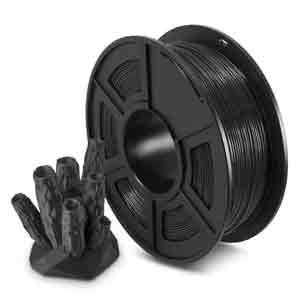
ABS (Acrylonitrile butadiene styrene)
ABS is a plastic widely used in engineering. It is a material with very good mechanical characteristics, especially it resists impacts very well. It is resistant to water, to most chemicals, but is not suitable for outdoor use. ABS prints at temperatures of 220-250 °C and bed temperatures of 95-110 °C.
ABS has several disadvantages. On the one hand, it is quite difficult to print, presenting warping (warping and layer delamination) during printing. In fact, it is advisable for the printer to be enclosed to avoid drafts. Furthermore, it emits (potentially toxic) fumes and odors, so it is not suitable for home use.
At the beginning of 3D printing it was frequently used, but take my advice, use PETG instead of ABS.
TPU (Thermoplastic polyurethane)
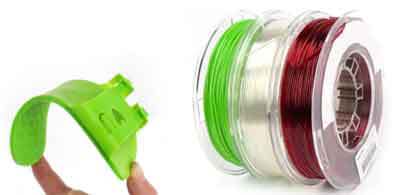
It is a plastic that has the property of being flexible. The printed parts are elastic and deformable.
However, it is somewhat difficult to print. In general, a direct drive printer is necessary.
PVA (Polyvinyl alcohol)
It is a water-soluble material, so it is very convenient for making supports in printers with dual extruders.
It frequently replaces HIPS, which was a soluble material that required chemical agents to dissolve it.
It is somewhat expensive, and of course, it is highly hygroscopic, so it must be stored in an airtight container when not in use.
ASA (Acrylic Styrene Acrylonitrile)
It is a material similar to ABS in terms of mechanical characteristics, but with greater resistance to UV rays, so it holds up better in outdoor applications.
It is quite expensive, and has the same problems as ABS in terms of printing difficulty and emission of fumes and odors.
PC (Polycarbonate), PA (Polyamide), Carbon Fiber
We finish by putting all these materials in the “same bag”. They all have excellent mechanical properties, but are extremely difficult to print.
We leave them there for now, because they are advanced materials and beyond the reach of most home printers.