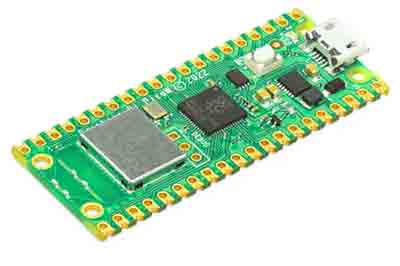
Today we woke up to the news of a new Raspberry Pi Pico W model. This variant of the Raspberry Pi Pico incorporates WiFi connectivity to the already well-known development board based on the RP2040 processor.
In January 2021, Raspberry Pi surprised us by presenting the Raspberry Pi Pico, a model that moved away from the product line we were used to, which mainly consisted of Linux-based mini computers.
As we saw in our analysis, the Raspberry Pi Pico would fall more into the field of what we call microcontrollers or MCUs. Thus, it would have characteristics similar to what we might find in a classic Arduino, rather than a “mini PC”.
As we pointed out at the time, the biggest flaw of the original Raspberry Pi Pico was the complete lack of connectivity. Something that was hard to understand these days, especially considering that the Raspberry Picos were announced as devices for the IoT field (?).
A year and a half later, Raspberry Pi has decided to fix this flaw, for which it is releasing the Raspberry Pi Pico W model. The new version adds a CYW43439 chip that connects to the RP2040 via SPI.
The CYW43439 is a low-cost chip from manufacturer Infineon, which includes Single-band 2.4Ghz Wi-Fi 4 (802.11n, 20 MHz channels, up to 96 Mbps PHY data rate) + Bluetooth® 5.2, WPA3, Wi-Fi Easy Connect™, enhanced Soft AP up to 4 clients, and SDIO v2.0 Host Interface (shared for Wi-Fi and Bluetooth).
However, in the first versions of the Raspberry Pi Pico W, the Bluetooth functionality will be disabled. It seems to be due to regulatory compliance issues, but they have left the door open for this functionality to be enabled in the future.
The rest of the board’s features remain, which we recall are summarized as:
{ “CPU and Memory”: [ { “label”: “Processor”, “value”: “Dual-core Arm Cortex-M0+ at 133MHz” }, { “label”: “Memory”, “value”: “264KB on-chip SRAM, 2MB on-board QSPI Flash” } ], “Connectivity”: [ { “label”: “WiFi”, “value”: “Single-band 2.4GHz Wi-Fi 4 (802.11n, up to 96 Mbps)” }, { “label”: “Power”, “value”: “Via Micro USB or VSYS pin (1.8 to 5.5V)” }, { “label”: “USB”, “value”: “Micro USB” }, { “label”: “Debug”, “value”: “SWD Port” }, { “label”: “Others”, “value”: [“Integrated LED”, “RTC”] } ], “Devices”: [ { “label”: “GPIO”, “value”: “26 pins” }, { “label”: “PWM”, “value”: “16 channels” }, { “label”: “ADC”, “value”: “3 of 12 bits (500 Kbps)” }, { “label”: “Interfaces”, “value”: [“2× UART”, “2× SPI”, “2× I2C”] }, { “label”: “PIO”, “value”: “2x programmable I/O with 8 state machines” }, { “label”: “PLLs”, “value”: “2x On-Chip for CPU and USB clock” } ], “Dimensions”: [ { “label”: “Dimensions”, “value”: “21 mm × 51 mm” } ] }
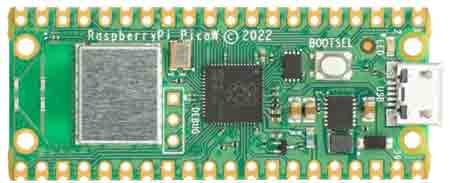
Regarding programming, the Raspberry Pi Pico W can be programmed with the Arduino environment and the usual languages like C/C++, MicroPython, and the usual tools of the ecosystem.
Now, although comparisons are odious, it’s time to compare it with our beloved ESP32, which is the undisputed king and the current benchmark to beat. The result is that the new Rpi Pico W gets close, but doesn’t quite make it.
If we review some of the ESP32’s features, as we saw in this post, the ESP32 is superior to the Rpi Pico W in every aspect. Dual Core 240Mhz, WiFi + BT, 512 SRAM, up to 16Mb memory, 32xGPIO, 16xPWM, 12-bit ADC 18 channels, 2 8-bit DACs, 3x UART, 4x SPI, 2x I2S, 2x I2C, CAN bus 2.0, 1x Motor PWM, 10x capacitive sensors, temperature sensor, hall sensor, RTC, random number generator, IR controller, we see that the ESP32 is simply inexhaustible.
However, it must be noted that the Raspberry Pi Pico W has a couple of interesting features. Especially, the PIOs are very tempting. As is the possibility of powering it directly from 1.8 to 5.5V, something very interesting for battery-powered applications.
Regarding price, the new Raspberry Pi Pico W is available for 6€ + shipping. This is a very interesting price compared to most official Arduino models. But higher than the ESP32, which we can have for 5€ at our doorstep.
On the other hand, as happened with the Raspberry Pi Pico, it is to be expected that this new development board will gain great acceptance and popularity within the community, driven by the “pull” and name of Raspberry Pi. This guarantees a large number of tutorials, projects, and documentation, improving the support for the new board.
In summary, the new Raspberry Pi Pico W comes to remedy the incomprehensible lack of connectivity of the Rpi Pico, which made it lose a lot of points in terms of interest. The new model, while not reaching the level of the ESP32, easily stands above a large number of current development boards.
Overall, the appearance of a new development board is good news. Competition between models contributes to improving future devices. In the same way, new tutorials and documentation contribute to improving the ecosystem.
The new Raspberry Pi Pico W is already available for purchase, and all information is available on the official page https://www.raspberrypi.com/products/raspberry-pi-pico/ and in the manual https://datasheets.raspberrypi.com/picow/connecting-to-the-internet-with-pico-w.pdf.