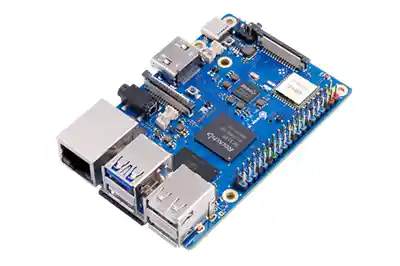
The Orange Pi 3B is an SBC (Single Board Computer) that has recently been launched on the market by the manufacturer Shenzen Xunlong Software.
Orange Pi is known for being a lower-cost alternative to the well-known Raspberry Pi. In this case, the Orange Pi 3B is a renewed version of its previous Orange Pi 3 model, which comes to “compete” with the Raspberry Pi 3 (yes, with the 3, not the 4).
The new board features a Rockchip RK3566 quad-core Cortex-A55 processor at 1.8 GHz, an Arm Mali-G52 2EE GPU, and an AI NPU accelerator.
On paper, the performance should be quite superior to the BCM2837 in the Raspberry Pi 3. Although, given the lack of benchmarks or tests on both SoCs, it’s difficult to assess the difference.
Regarding RAM, the Orange Pi 3B comes in three different configurations of 2GB, 4GB, and 8GB (LPDDR4/4x). 2GB doesn’t seem very suitable for that processor, so I would advise you to go for the 4GB or 8GB models.
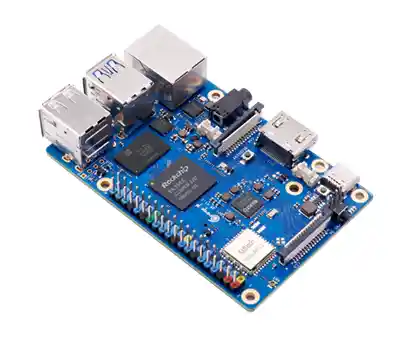
Among the available storage options are an optional eMMC module socket, a microSD card slot, an M.2 Key-M socket for NVMe or SATA III SSDs, and additional SPI flash memory that enables features like network boot.
In terms of connectivity, the Orange Pi 3B offers the usual Gigabit Ethernet port, a WiFi 5 wireless module, and Bluetooth 5.0.
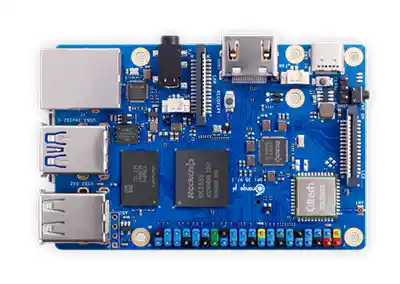
On the other hand, regarding connections, we have four USB ports, MIPI DSI and CSI connectors. Plus a 40-pin header, compatible (pinout) with the Raspberry Pi’s, with up to 28 GPIOs, UART, I2C, and SPI.
Another very interesting point is that it has a form factor similar to the Raspberry Pi 3B (not to say they’ve literally copied the layout of the elements). This makes it compatible with most accessories and projects.
{ “CPU and Memory”: [ { “label”: “SoC”, “value”: “Rockchip RK3566” }, { “label”: “CPU”, “value”: “Quad-core Cortex-A55 @1.8 GHz” }, { “label”: “Memory”, “value”: “2GB, 4GB or 8GB LPDDR4/4x” }, { “label”: “GPU”, “value”: “Arm Mali-G52 2EE (OpenGL ES 1.1/2.0/3.2, OpenCL 2.0, Vulkan 1.1)” }, { “label”: “NPU”, “value”: “AI accelerator 0.8 TOPS” } ], “Storage”: [ { “label”: “eMMC”, “value”: “Socket for optional module (16GB-256GB)” }, { “label”: “microSD”, “value”: “Card slot” }, { “label”: “SPI Flash”, “value”: “16 MB or 32 MB” }, { “label”: “M.2”, “value”: “M-Key for SATA III or NVMe PCIE 2.0 SSD” } ], “Connections”: [ { “label”: “GPIO Header”, “value”: “40-pin Raspberry Pi compatible (28 GPIOs)” }, { “label”: “Interfaces”, “value”: [“UART”, “SPI”, “I2C”, “PWM”] }, { “label”: “Video”, “value”: [“HDMI 2.0 4Kp60”, “2-lane MIPI DSI”, “eDP 1.3”] }, { “label”: “Camera”, “value”: “2-lane MIPI CSI” }, { “label”: “Audio”, “value”: “3.5 mm headphone jack” }, { “label”: “USB”, “value”: [“1x USB 3.0 host”, “2x USB 2.0 host”, “1x USB 2.0 device/host”] } ], “Connectivity”: [ { “label”: “WiFi”, “value”: “Dual-band 5” }, { “label”: “Bluetooth”, “value”: “5.0” }, { “label”: “Ethernet”, “value”: “Gigabit RJ45” } ], “Power”: [ { “label”: “Power”, “value”: “5V/3A via USB Type-C” }, { “label”: “RTC Battery”, “value”: “2-pin connector” } ], “Dimensions and Weight”: [ { “label”: “Dimensions”, “value”: “85 x 56 mm” }, { “label”: “Weight”, “value”: “49 grams” } ] }
Regarding prices, we have different configurations to choose from, with these approximate prices.
- 2 GB RAM for 35€
- 2 GB RAM + 32GB eMMC for 40€
- 4 GB RAM for 40€
- 4 GB RAM + 64GB eMMC for 45€
- 8 GB RAM for 50€
- 8 GB RAM + 256GB eMMC for 70€
Personally, the 4 GB RAM + 64GB eMMC model for 45€ seems the most interesting to me. And, in all cases, I would opt for the one that includes eMMC, because the SD card is one of the biggest problems with Raspberry Pis.
As is usual with Orange Pis, the Orange Pi 3B is compatible with several operating systems, including Android 11, Ubuntu 22.04, Ubuntu 20.04, Debian 11/12, OpenHarmony, Orange Pi OS (Arch), Orange Pi OS (OpenHarmony) among others.
In short, a quite interesting “beast” in terms of features / price ratio. The 4GB + 64GB eMMC model seems very interesting to me. The fact that it is compatible in form and GPIO with the Raspberry Pi 3 is also a plus.
It probably isn’t as simple a machine to learn on as a Raspberry Pi, given that one of the latter’s strengths is its documentation and simplicity. But if you already have some experience with Linux mini PCs, the Orange Pi 3B is a more than interesting option for your projects.