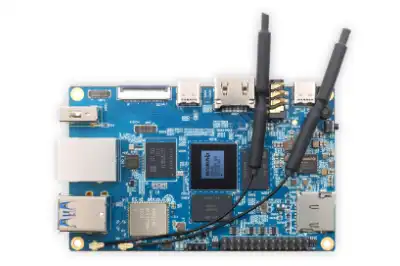
The Orange Pi 5B is a Linux mini PC that mounts an 8-core Rockchip RK3588S (4x @2.4Ghz + 4x 1.8Ghz), and incorporates WiFi 6 and BLE 5.0 connectivity.
Orange Pi is known for traditionally providing development boards and Linux mini PCs, as lower-cost alternatives to a Raspberry Pi 4. Although in recent times the price has increased, comparatively it has done so much less than Raspberry Pis.
The Orange Pi 5B debuts as a successor to the Orange Pi 5 model, incorporating eMMC flash storage and Bluetooth 5.0 connectivity. The eMMC storage seems like a very appreciated feature to me, as the robustness and speed compared to a micro SD is frankly desirable.
It mounts a Rockchip RK3588S Octa Core processor, which is currently one of the best processors in terms of price/performance ratio. This processor features 4 Cortex-A76 cores at 2.4 GHz + 4 Cortex-A55 cores at 1.8 GHz. This configuration allows for high performance combined with low power consumption.
Regarding memory, the Orange Pi 5B is available in different versions, which differ precisely in the available memory. We find models with RAM memory of 4/8/16GB and eMMC storage of 32/64/128/256GB.
As we can see, we are entering a range of specifications where talking about “micro pcs” starts to not even be correct. It’s actually an impressive machine.
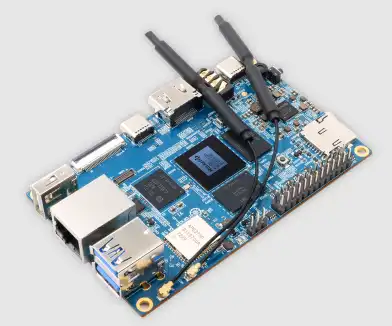
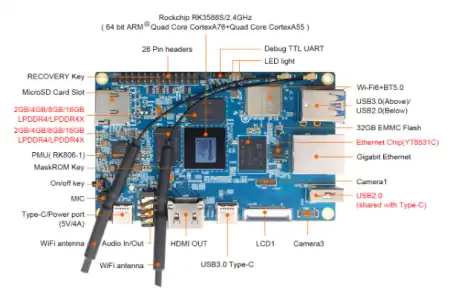
{ “CPU and Memory”: [ { “label”: “CPU”, “value”: “Rockchip RK3588S Octa Core (4x Cortex-A76 @2.4 GHz + 4x Cortex-A55 @1.8 GHz)” }, { “label”: “GPU”, “value”: “Arm Mali-G610 MP4” }, { “label”: “AI Accelerator”, “value”: “6 TOPS” }, { “label”: “RAM”, “value”: “4GB, 8GB or 16GB LPDDR4” }, { “label”: “Storage”, “value”: [“32GB-256GB eMMC flash”, “16MB QSPI NOR Flash”, “MicroSD card slot”, “M.2 2242 socket for NVMe SSD”] } ], “Connectivity”: [ { “label”: “Video”, “value”: [“HDMI 2.1 8Kp60”, “DisplayPort 1.4 8Kp30 via USB-C”, “2x 4-lane MIPI DSI 4Kp60”] }, { “label”: “Ethernet”, “value”: “Gigabit RJ45” }, { “label”: “Wi-Fi”, “value”: “6” }, { “label”: “Bluetooth”, “value”: “5.0” }, { “label”: “USB”, “value”: [“1x USB 3.0”, “1x USB 3.1 Gen 1 (5 Gbps) Type-C”, “2x USB 2.0”] }, { “label”: “Audio”, “value”: “Codec ES8388 with 3.5 jack for speaker and microphone” } ], “Devices”: [ { “label”: “Cameras”, “value”: “Up to 3 (1x 4-lane MIPI CSI, 2x MIPI DCPHY)” }, { “label”: “Expansion Port”, “value”: “26-pin header (17x GPIO, 3x UART, 6x PWM, 2x I2C, 2x CAN)” } ], “Power and Dimensions”: [ { “label”: “Power Supply”, “value”: “5V/4A via USB-C” }, { “label”: “Dimensions”, “value”: “100 x 62 mm” }, { “label”: “Weight”, “value”: “52 grams” } ] }
In terms of performance, the Orange Pi 5B is capable of handling simple and complex tasks without problems. For comparison, the estimated performance is 3 to 4 times higher than that of a Raspberry Pi 4. That is, it is a really powerful machine.
Regarding Software, we have images for Orange Pi OS (Android), Debian 11, Ubuntu 22.04, Ubuntu 20.04, and Android 12.
The price of the Orange Pi 5B:
- 89.90€ for the 4GB RAM and 32GB eMMC flash model
- 115.00€ for the 8GB RAM and 64GB eMMC flash model
- 149.00€ for the 16GB RAM and 128GB eMMC flash model
- 169.00€ for the 16GB RAM and 256GB eMMC flash model
Which, if we compare it with the current price of Raspberry Pis and the specifications it has, is quite interesting. Especially, in my opinion, the 115€ model, if we are actually able to find it at that price.
Finally, it’s worth noting that, as is often the case with these boards, the use is not as simple and “hand-holding” as with Raspberry Pi. In general, if you opt for one of these boards, it’s advisable that you have previous experience using Linux, searching for images, reading forums, etc.