Qucs (Quite Universal Circuit Simulator) is open-source software for electronic circuit simulation distributed under the GNU GPL license.
Qucs is a simple yet functional alternative to more complex and professional solutions like gEDA or PSPICE. It is sufficient for working with small to medium-sized circuits and is suitable for all levels. Furthermore, it is one of the few Open Source alternatives in this field.
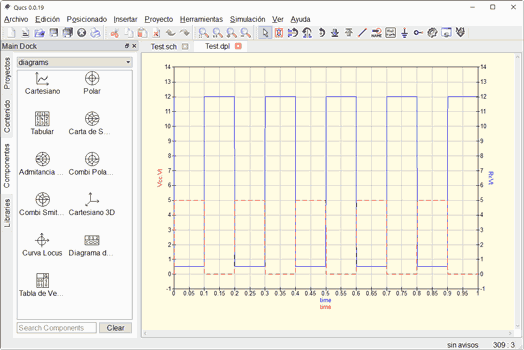
Editing and simulating electrical circuits in Qucs is done through a graphical interface. Results can be visualized in various plots, including Cartesian, tabular, polar, and timing diagrams.
With Qucs, it is possible to work with analog and digital circuits, and perform large-signal, small-signal, and electronic noise simulations. Additionally, it allows the incorporation of subcircuits modeled in SPICE and simulation of digital circuits using VHDL and/or Verilog.
Its use is straightforward. Using the graphical interface, we model the circuit we want to create simply by dragging components from the library and connecting them with wires. The overall use is quite intuitive and pleasant.
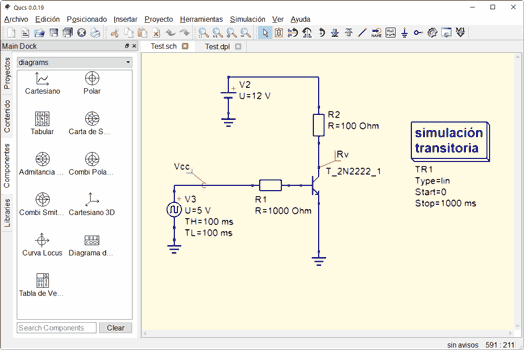
Qucs includes a library with a considerable number of electronic components, covering the usual needs for most electrical circuits.
Next, we must add a simulation from among the available options and adjust its parameters. We also need to configure the result window by adding the variables we want to monitor, including the necessary plots and indicators. Finally, we run the simulation.
Qucs is compatible with Windows, GNU/Linux OS, and MacOS. Its latest official version is v0.19 from 2017. However, v0.20rc2, dated May 2019, is already available on Github.
Nevertheless, Qucs is still a project under development and, therefore, not entirely free of bugs. For example, transient simulations sometimes throw errors, although they can often be fixed simply by slightly adjusting the simulation parameters.
You can find more information on the product’s website http://qucs.sourceforge.net/. The code is available at https://github.com/Qucs/qucs.
In short, a very interesting program that allows us to simulate electronic circuits. It is simple but quite powerful and covers most cases. A good alternative to more complex solutions, fitting perfectly in the domestic and educational fields.