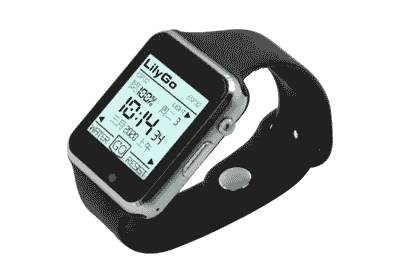
Today it’s time for a review of the LilyGo T-Watch 2020, a little toy that the Three Wise Men kindly brought me this Christmas.
The T-Watch 2020 is a quite popular programmable watch from the manufacturer LilyGo. It is based on the ESP32, a well-known acquaintance of the blog, and the great thing is that we have total freedom to program it with our own code.
The ESP32 endows the T-Watch 2000 with the features we are already accustomed to. This Espressif MCU has a dual-core 80Mhz, with 520KB SRAM, plus 8MB PSRAM, and 16MB QSPI flash. Of course, the ESP32 provides Wi-FI 802.11 b/g/n and Bluetooth v4.2BR/EDR/BLE connectivity.
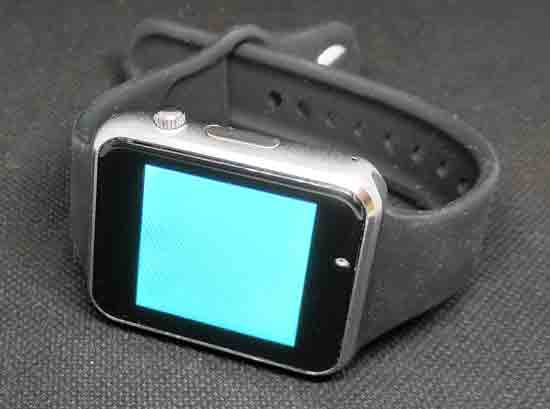
The chosen display is a 1.54-inch color TFT, with a resolution of 320x240 pixels, which incorporates a capacitive touch panel. The visibility and colors of the screen and the sensitivity of the touch panel are good.
The T-Watch 2020 case is one of the positive points of the set. The frame is metal, with rounded edges and a good finish. The overall appearance is robust and of good quality.
The dimensions of the watch (without strap) are 47mm x 40mm and a thickness of 13mm, with a weight of 58g. In use, it is a comfortable, light, and pleasant device to handle.
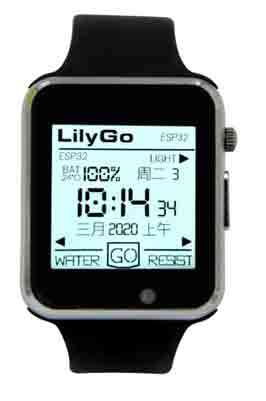
We cannot say the same about the strap, which is clearly one of the weakest points of this wearable. Not only because it is not comfortable or particularly aesthetic, but also because it closes really poorly. On the other hand, the strap is integrated and fixed with the frame, so it is not possible to remove it.
On the frame, we find a round button that has both a push-button function and a two-directional scroll wheel. Both functions work correctly, and the scroll wheel is surprisingly precise, without skipping steps.
Just below we find the port to connect the watch via micro USB, covered by a small plastic cap. This is also a point to improve on the T-Watch 2020. On one hand, a USB Type-C would be appreciated. Furthermore, the cap seems fragile and is annoying during programming.
Regarding electronics, the T-Watch 2020 is full of devices and sensors. Thus, it incorporates a 3-axis accelerometer BMA424, which includes step counting, activity recognition, and gesture recognition functions.
It also incorporates a microphone, a speaker with a MAX98357 amplifier connected via I2S, a PCF8563 RTC clock, and a vibration motor.
The T-Watch 2020 incorporates a 3.7V lithium battery, and the power management is controlled by an AXP202 PMU integrated circuit, whose data is accessible via I2C.
The battery life is reasonable. And I say “reasonable” because at the same time, it’s one of the points that really prevents using the T-Watch as a daily watch. By optimizing deep-sleep mode and restricting the use of Bluetooth and WiFi to a minimum, we can achieve up to 3 days.
Obviously, if we have the screen on, communications active, and push the processor hard, the battery will last us half an hour. But in a device of this size and weight, we knew from the start that consumption would be a critical point.
As for the packaging, it is more than correct, as is usual with LilyGo products. The watch comes presented in a sturdy plastic box, which includes the watch, connection cable, and instructions.
Programming the T-Watch is no different from programming any ESP32. Therefore, it is possible to program it in C++, Micropython, Scratch. For the Arduino environment, a library is provided available at https://github.com/Xinyuan-LilyGO/TTGO_TWatch_Library
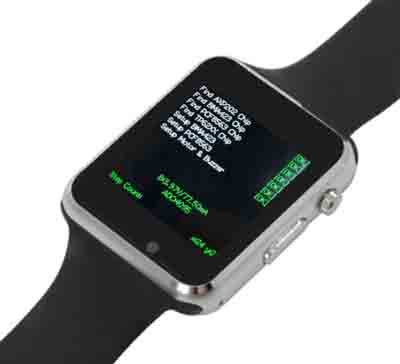
The documentation on the website, as is often the case with LilyGo products, is not one of the highlights. On the contrary, the library includes many examples, some of them very interesting. Among these, an implementation of a watch with WiFi, Bluetooth, GPS functions stands out.
The price of the T-Watch is around 35€. It is a reasonable price considering the processor, memory, screen, battery, and sensors it incorporates, placing it in a similar or lower range than other devices with similar characteristics.
In my opinion, it would have been a good decision to allow the strap to be removed and detached, to allow using the T-Watch 2020 as an independent processor in other types of projects. This way we would have something similar to an M5Stack, but with the added possibility of wearing it on the wrist.
In conclusion, the T-Watch is a toy and a little indulgence. Obviously, it doesn’t really work as a daily-use watch, mainly because of its strap and battery. In this case, we have much better commercial options, like a smart band from Xiaomi or Huawei.
However, you most likely don’t want the T-Watch as a watch but as a wearable to load your projects onto and “play” with. In this case, you will find the T-Watch a very interesting device.