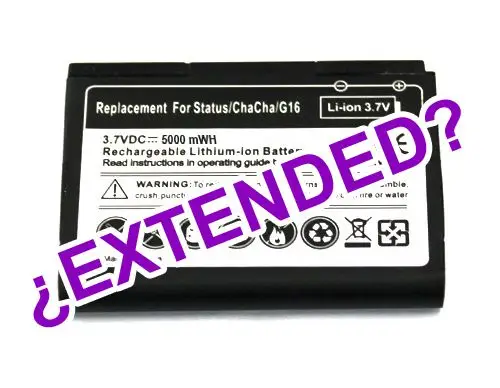
It’s been days since I last published, as I’ve been busy with many things and haven’t had time to write anything. But today I was at Mediamarkt (a store that, in case you didn’t know, is ridiculously expensive) and I saw something that should almost be considered deceptive advertising, and it’s also hard to detect. I’ll give you the specific case I saw with a Samsung Galaxy S2 battery, although this obviously happens with other phones and in other stores as well. At the end of the article, I include a brief mathematical explanation for those interested.
A Samsung Galaxy S2 comes standard with a 1650 mAh battery. Besides original batteries and a higher capacity 1800 mAh one, they were also selling batteries of 3300, 5000, and 6100 mWh. WATCH OUT, here’s the trick! mWH. Logically, it seems like a much larger battery, and in fact, it was more expensive than the original replacement. But, how do we convert mWh to mAh? By dividing by the battery voltage, i.e., 3.7V. Thus, the capacities of these “extended batteries” actually turn out to be 890, 1350, and 1650 mAh, respectively. The “scam” is that the 6100 mWh battery cost 10 euros more than the original, even though they have the same capacity. So be careful, pay attention to the units, not just the price.
As advice, I recommend you only use original batteries in your phones. Lithium-ion batteries are complex, and a cheap manufacturing process usually means lower charges and a shorter lifespan. And certainly, be wary of “miracle” batteries. Lithium-ion technology has a charge limit relative to its volume, and factory batteries are around this maximum, so it’s very difficult for a “Chinese” battery to have a higher charge capacity.
Now for those who feel like a dense explanation, a bit of mathematical rambling.
The energy stored in a battery should be measured, according to the SI, in Joules (J). Since Energy = Power x Time, the Watt-hour (Wh) is accepted as an alternative unit of energy, which is the amount of energy equivalent to a power of one Watt (W) over a time of one hour, i.e., 1 Wh = 3600 J. However, historically, batteries are measured in mAh (milliamp-hours), and this is due to the relationship Power = Current x Voltage. Given a constant nominal voltage in a battery, its charge capacity can be expressed as the product of electrical current, measured in Amperes (A), and time. From this, it follows that the capacity of a battery in mWh can be obtained from its capacity in mAh multiplied by its nominal voltage. Thus, a 1.5V alkaline battery with 2000 mAh stores an energy of 3000 mWh, and a hypothetical 3.7V lithium-ion battery with 2000 mAh would store an energy of 7400 mWh.