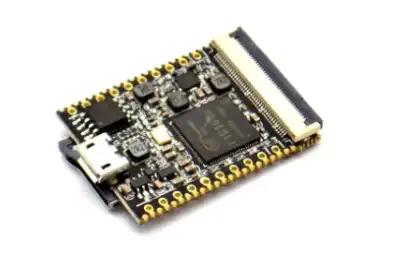
The Sipeed Lichee Nano is a Linux-based development board that is similar in size to an SD card and costs around €10.
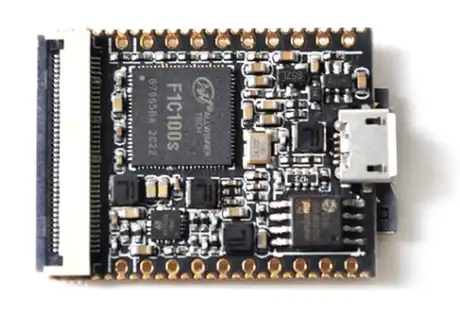
The Lichee Nano uses an Allwinner’s F1C100s (ARM9) processor that runs at speeds up to 900MHz. It’s a processor with some age, no longer actively used in current devices. Sipeed has intelligently decided to reuse this processor for creating development boards. Personally, I find it one of the most interesting products that has appeared.
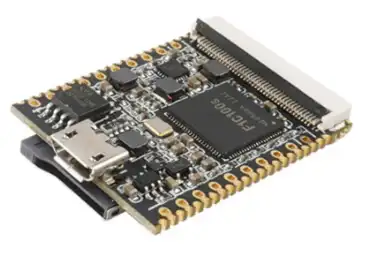
Lichee Nano features 32MB of integrated DDR memory within the SoC itself. Storage can be expanded via an 8-32MB SPI Flash memory or via a micro SD card.
In terms of connectivity, the LicheePi Nano has several input and output ports including, 2x SPI, 3x TWI (I2C), 3x UART, 1x TV out, 2x TV in, 2x PWM, 1x LRADC, 2x speaker outputs and 1x microphone input. It also has a micro USB OTG port.
The board also features a 40-pin RGB LCD connector that supports resistive and capacitive touchscreens with resolutions of 272×480, 480×800, 1024×600, and video decoding goes up to H.264/MPEG with resolution up to 720p.
Unfortunately, it lacks wireless WiFi or Bluetooth connectivity. But it includes an SDIO connection for BT or WiFi modules (though the price of the module costs almost as much as the board itself!)
Regarding power, it can be supplied via 5V input through the micro USB port, and 3.3 to 5V through pins. The board also has a 3.3V output and selectable RTC input voltage. Power consumption is 54mA (idle) with Linux and 250mA with the screen on.
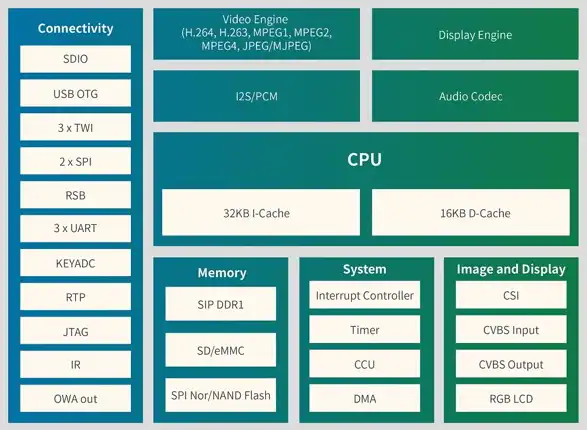
{ “CPU and Memory”: [ { “label”: “SoC”, “value”: “Allwinner F1C100s ARM926EJS @900MHz” }, { “label”: “Memory”, “value”: “32MB integrated DDR” } ], “Storage”: [ { “label”: “Storage”, “value”: [“Micro SD Card”, “Optional 8MB SPI Flash”] } ], “Interfaces”: [ { “label”: “SPI”, “value”: “2x” }, { “label”: “I2C”, “value”: “3x TWI” }, { “label”: “UART”, “value”: “3x” }, { “label”: “PWM”, “value”: “2x” }, { “label”: “LRADC”, “value”: “1x” }, { “label”: “TV”, “value”: “1 output, 2 inputs” }, { “label”: “Audio”, “value”: “2 speaker outputs, 1 microphone input” }, { “label”: “USB”, “value”: “1x micro USB OTG” }, { “label”: “SDIO”, “value”: “For WiFi module” } ], “Devices”: [ { “label”: “Display”, “value”: “40-pin FPC LCD RGB connector” }, { “label”: “Video”, “value”: “H.264/MPEG decoding up to 720p” } ], “Power”: [ { “label”: “Power Supply”, “value”: “5V micro USB, 3.3-5V pins” }, { “label”: “Consumption”, “value”: “54mA idle Linux, 250mA with display” } ] }
The LicheePi Nano is compatible with three different operating systems: Linux, RT-Thread (RTT), and Xboot. However, due to the board’s RAM capacity, running a full desktop environment is not recommended.
The Lichee Nano was launched at a price of around €8, but currently it’s hard to find one. You might find them for €11-12 if you’re lucky in your search.
On the other hand, the available documentation about the board is scarce and is exclusively in Chinese. Furthermore, as is often the case with these types of products, it’s not an easy device to use.
Beyond the interest of the board itself, which I must say is rather relative, the most interesting aspect is the emergence of low-power Linux-based development boards. A trend we have been observing for some time, and one that will likely become more frequent.
So yes, as we hope will happen, if Linux is destined to take a significant share of the IoT pie in the future, boards like the Lichee Nano allow us to taste the first flavors. For that reason alone, it’s a very interesting board.
References: