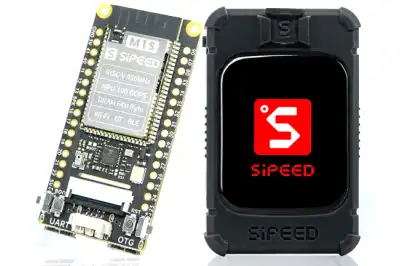
The Sipeed M1s Dock is a development board with three RISC-V cores and WiFi, Bluetooth 5.0, and Zigbee connectivity, compatible with FreeRTOS and Linux.
The Sipeed M1S module is an AIOT module based on the Bouffalo Lab BL808. The M1s Dock, on the other hand, is a development board from Sipeed itself, based on this module.
The M1s aims to become a competitor for the ESP32. It is oriented towards IoT applications, thanks to its connectivity capabilities, especially in TinyML and edge computing applications.
The board features a CPU that incorporates 3 RISC-V cores, which can play a role in high computing power.
- Core 1: Alibaba T-head C906 64-bit RISC-V (RV64GCV+) @ 480MHz
- Core 2: Alibaba T-head E907 32-bit RISC-V (RV32GCP+) @ 320MHz
- Core 3: 32-bit RISC-V (RV32EMC) @ 160 MHz
The Sipeed M1s also has 768 KB of SRAM and 64 MB of integrated PSRAM, giving it acceptable capacity for data processing tasks.
Furthermore, the module includes an artificial intelligence accelerator (NPU) called BLAI-100, which is capable of performing audio and video detection and recognition tasks at speed.
Wireless connectivity is another strong point. It features 2.4 GHz WiFi, dual-mode Bluetooth 5.x (classic and BLE), which can be used simultaneously, and Zigbee.
Regarding multimedia, it integrates video processing modules such as DVP/CSI/H264/NPU, which can be widely used in various AI fields like video surveillance/smart speakers.
It also has an SPI display interface, a MIPI CSI and DVP camera interface, and support for audio via I2S and analog input/output. In addition to an RMII Ethernet port and a USB 2.0 OTG HS port.
{ “CPU and Memory”: [ { “label”: “SoC”, “value”: “Bouffalo Lab BL808 with 3-core CPU” }, { “label”: “AI Processor”, “value”: “NPU BLAI-100 (Bouffalo Lab AI engine)” }, { “label”: “Memory”, “value”: “768KB SRAM and 64MB PSRAM” }, { “label”: “Storage”, “value”: “16MB NOR flash” } ], “Connectivity”: [ { “label”: “Video”, “value”: “H.264 up to 1920×1080” }, { “label”: “WiFi”, “value”: “4, 2.4 GHz 802.11 b/g/n” }, { “label”: “Bluetooth”, “value”: “5.x” }, { “label”: “Zigbee”, “value”: “IEEE 802.15.4” }, { “label”: “USB”, “value”: “2.0 OTG HS” } ], “Devices”: [ { “label”: “Interfaces”, “value”: “UART, I2C, SPI, SDIO, ADC/DAC” }, { “label”: “Display I/F”, “value”: “SPI, 8-bit MCU, RGB LCD” }, { “label”: “Camera I/F”, “value”: “MIPI CSI and DVP” }, { “label”: “Audio”, “value”: “I2S and analog input/output” } ], “Dimensions”: [ { “label”: “Dimensions”, “value”: “31 x 18 mm” } ] }
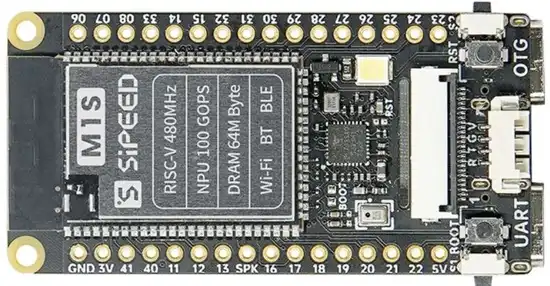
To these features provided by the M1s module, the dock adds:
- SD card reader
- UART connector
- 2 rows of 16 pins for GPIO
- Reset button, boot button, and two additional “free” buttons
- USB Type-C port
- Total dimensions 55 x 27mm
Finally, the Sipeed M1s Dock can be optionally purchased with a 1.69” 280 x 240px capacitive touch panel display, and a 2MP camera with an OV2685 sensor and LED Flash.
The system runs on FreeRTOS. It is “in theory” compatible with Linux. But I put that in quotes because the manufacturer itself says it’s partial, and with a very reduced version.
We can purchase a Sipeed M1s Dock for about €14, shipping included, or €25 if we buy it with the camera and the 1.69-inch touch screen.
More information,
- M1s: https://wiki.sipeed.com/hardware/en/maix/m1s/m1s_module.html
- M1s dock: https://wiki.sipeed.com/hardware/en/maix/m1s/m1s_dock.html
- Github : https://github.com/Sipeed
- SDK : https://github.com/sipeed/M1s_BL808_SDK
- Examples: https://github.com/sipeed/M1s_BL808_example