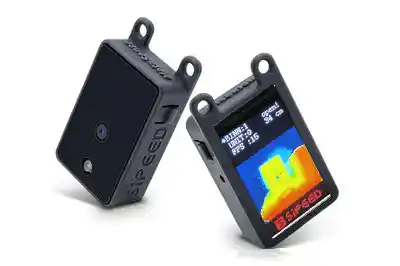
The Sipeed MaixSense A010 Camera is probably the cheapest depth camera you’ll find to add to your project.
Instead of capturing color, depth cameras capture the distance to the nearest obstacle in each pixel. They are the most advanced and powerful distance sensors you can incorporate into your project.
Generally, depth cameras include a normal camera, being called RGBD cameras (color + depth). But, in general, the cheapest ones are around 100€. Which for a domestic robot… starts to get expensive.
Furthermore, they usually require connection via USB to a computer, with higher power consumption, etc. In short, they are reserved for “medium and large” robots.
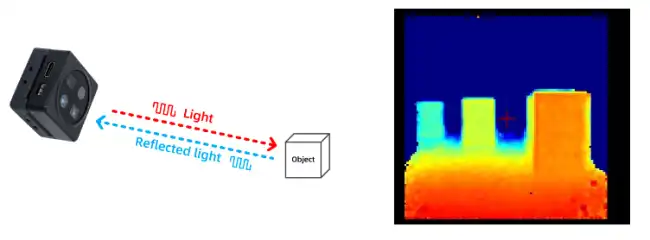
In this case, the Sipeed MaixSense A010 stands out by betting on a very interesting low-cost option, dispensing with the color channel and keeping only distance measurement. Achieving a device with a price of around 30€.
For its operation, the MaixSense A010 is powered by a Bouffalo BL702 SoC. A 32-bit RISC-V microprocessor running at 144Mhz, with 132KB RAM / 192KB ROM memory.
As for the sensor, we find a time-of-flight (TOF) OPNOUS TOF sensor with a maximum resolution of 100x100 pixels and an 8-bit precision. The measurement range is from 200 to 2500mm, with a resolution of 10mm.
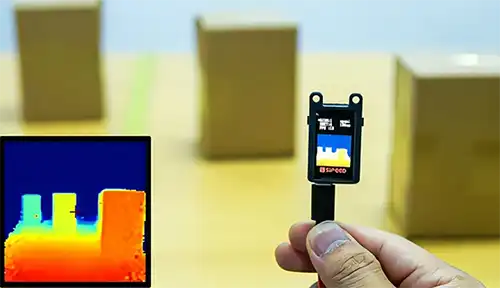
Additionally, it also incorporates a 1.14” LCD screen with 240x135 pixels, which provides a real-time preview of the depth map after applying the color map.
{ “CPU and Memory”: [ { “label”: “Processor”, “value”: “Bouffalo BL702 32bits RISC-V @144Mhz” }, { “label”: “Memory”, “value”: “192KB ROM, 132KB RAM” } ], “Connectivity”: [ { “label”: “Connection”, “value”: [“UART”, “USB Type-C”] } ], “Sensor”: [ { “label”: “Sensor”, “value”: “OPNOUS TOF 100x100px @20fps” }, { “label”: “FOV”, “value”: “70º H, 60º V” }, { “label”: “Range”, “value”: “0.2 to 2.5 meters” }, { “label”: “Distance measurement”, “value”: “8bits, 1cm resolution” } ], “Display”: [ { “label”: “Display”, “value”: “1.14inch TFT”} ], “Dimensions and Weight”: [ { “label”: “Dimensions”, “value”: “23 x 40 x 10 mm” }, { “label”: “Weight”, “value”: “10 grams” } ] }
Regarding connection, unlike “normal” RGBD cameras, which as I said need a computer, the Sipeed MaixSense A10 can be connected directly to an MCU like an Arduino or an ESP32.
This is very interesting, because we can add it directly connected to an ESP32, for example, and use it as a distance sensor on a “small” robot.
We don’t need a full computer (like a Raspberry Pi). Which, on a robot, means more weight, more consumption -> larger batteries -> larger motors -> more weight. And so the cycle continues, and in the end all that translates into more money. 💸
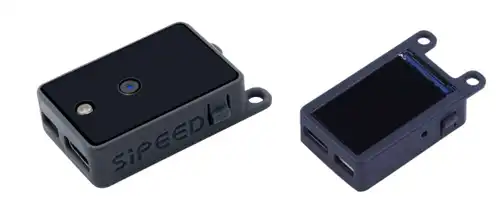
However, it is also possible to connect it to a computer via USB and perform image processing from there. Furthermore, compatibility with ROS (Robot Operating System) further expands the applications of the MaixSense-A010.
Integration with ROS facilitates the incorporation of this module into complex robotic systems. The precise 3D vision data can be leveraged for tasks such as autonomous navigation, object detection, and route planning.
As I said, the strongest point of the Sipeed MaixSense A010 is its price and the ability to connect to an MCU. The resolution is lower than that of “usual” RGBD cameras and it lacks a color channel. But, on the other hand… it only costs 30€!
Sipeed also has higher-end models, like the MaixSense A075V, which incorporate RGBD sensors (color + depth). But of course, that goes up to 500€, so they are far from the domestic sector.
However, the Sipeed MaixSense A010 seems like a very appealing device to me. You won’t find a cheaper depth camera, nor a remotely similar distance sensor to connect to your electronics project.
References
MaixSense-A010 - Sipeed Wiki MaixSense-A075V - Sipeed Wiki Sipeed · GitHub Documentation