With signs of improvement and a gradual recovery of the global economy beginning to appear, new job offers are slowly emerging in the labor market. Currently, within the field of engineering, one of the most in-demand positions is that of a process improvement expert.
It’s worth mentioning how curious it is that interest in improving productivity arises at the end of a recession process. The correct approach would have been to make these improvements before or even during it. We should consider that we still have a terrible misunderstanding regarding process improvement. Precisely, the worse the situation, the greater the investment we should make in improving our efficiency to reduce costs.
In any case, the truth is that it can be an overwhelming task, especially for novice engineers, to undertake a comprehensive process improvement initiative in a small or medium-sized company that, due to economic circumstances, has stopped or reduced its investment in process improvement for some time.
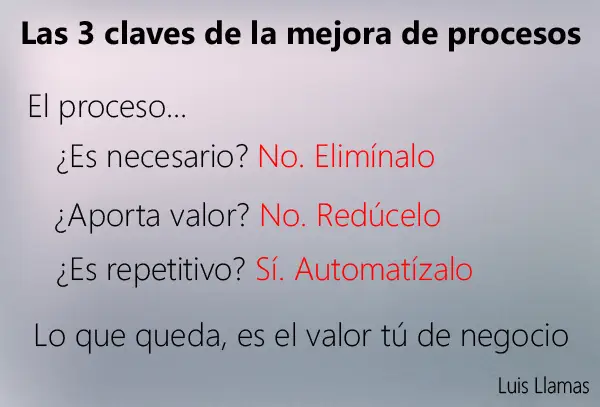
I share with you what, for me, are the 3 keys that guarantee success in process improvement.
- Eliminate unnecessary processes. Quite self-descriptive. If a process can be classified as unnecessary, it shouldn’t exist. If there’s no reason for it to exist, it’s a superfluous expense and must be eliminated. A clear example is a large part of waiting times and material movements, which can be eliminated by redistributing the production space.
- Reduce processes that don’t add value. Understanding product value as that which our customer would be willing to pay for, it’s obvious that some of our processes don’t add value, but we still need to do them. For example, cleaning the offices or managing your MRP don’t add value for the customer, but they are fundamental for the company’s correct operation. In these cases, these processes must be identified and minimized as much as possible.
- Automate repetitive processes. Automation is the best friend of process improvement. But not only in direct production processes. Automation should also be integrated into offices and, in general, throughout the company’s workflow, helping to reduce unnecessary bureaucracy and indirect costs. Ultimately, any process that doesn’t require creative skills or decision-making subject to unpredictable factors should be performed automatically.
These points are the direct result of applying Lean Manufacturing practices, conveniently reduced and synthesized. They are 3 simple, easy, clear, and easy-to-understand and remember rules that should accompany you and become your best friends throughout any improvement process.
Of course, being easy to understand doesn’t mean it’s easy to put into practice. Distributing space in a factory to improve versatility, reduce waiting times, and transport is usually manageable. Undertaking a comprehensive reform of a company’s workflow to reduce non-value-adding tasks, eliminate bureaucracy, and automate processes… can be a titanic task.
Nevertheless, keeping these 3 rules in mind and applying them properly at the right time will allow us to get a little closer to success.