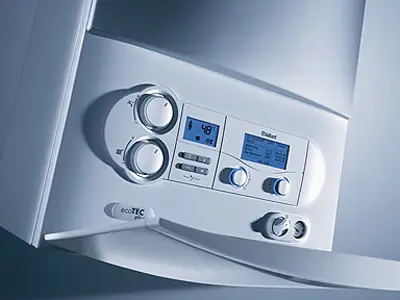
Boilers are a fundamental element in the climate control of most buildings and, therefore, are one of the main elements involved in energy efficiency. Precisely due to this importance, a large part of the energy-saving measures that arise in an energy audit fall on the improvement and verification of these heat generators.
Boilers transform the energy stored in fuel into heat available for use in the building. Obviously, the boiler’s performance greatly affects the efficiency of the installations. An inefficient boiler will directly result in higher fuel consumption and, therefore, higher economic cost.
There is a great diversity of boilers. Each type of boiler has its own characteristics, which give it a performance and appropriate conditions of use. It will be the task of a specialized technician to decide the most suitable type of boiler for each particular installation, considering criteria of suitability both in terms of energy and economics.
Types of boilers based on draft type:
- Natural draft
They use the difference in density of the exhaust gases, which are at a higher temperature, for evacuation. They require a high exhaust gas temperature, which means lower performance. They are falling out of use and are usually applied exclusively to low-performance atmospheric boilers.
- Forced draft
They use a fan to force the extraction of gases. The extraction fan implies a small additional consumption, which is more than compensated for by the increase in performance that can be achieved by lowering the exhaust gas temperature.
Types of boilers based on combustion chamber type:
- Atmospheric boilers (efficiency 70-80% LHV)
They perform combustion in a non-insulated chamber and take air from the room or space where they are installed. Gas evacuation is carried out through a gas evacuation pipe with a draft diverter. Their efficiencies are low mainly because they do not allow regulation of the oxygen amount in the combustion. Furthermore, they pose a risk to users since, in case of failure, they can release toxic combustion gases into the room. The acquisition of atmospheric boilers has been prohibited since January 1, 2010.
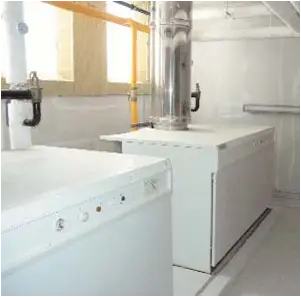
- Sealed combustion boilers (efficiency 80-90% LHV)
They perform combustion in a sealed chamber, completely independent of the room in which they are installed. They take air from outside the space via a double concentric pipe that allows the entry and exit of gases. They are always forced draft, as the gas draft does not have enough force to perform the suction and expulsion of gases. They have higher efficiencies and provide greater safety for the user.
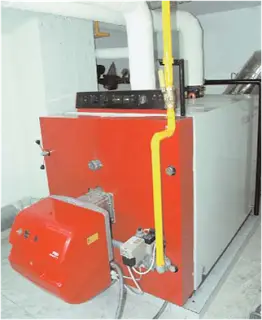
Other boiler classifications
The following terms and types of boilers are common within climate control installations and energy efficiency improvements.
Low NOx boilers These are boilers equipped with systems to reduce the amount of boiler gases. It is not a type of boiler per se, it is a characteristic. However, it is commonly used to refer to a boiler similar to a conventional sealed combustion boiler, with systems to reduce its emissions. Its efficiency is slightly higher than a conventional boiler.
Low-temperature boilers They are designed to work with very low water return temperatures (40°C, compared to 70°C for a conventional one). This translates into higher performance, around 95-98% of LHV. The materials of these boilers are designed to withstand the condensation and acid formation that these low return temperatures cause, which would damage a conventional boiler in a short time.
Condensing boilers This is a special type of boiler, specifically designed to avoid losses from water vapor in the emitted flue gases. To do this, they operate at very low emission (40°C) and return (30°C) temperatures, to prevent the formation of water vapor. They achieve the highest performance, up to 108-110% of LHV. However, they require special heating systems, such as underfloor heating or very high-surface radiators, to be able to work with such low temperatures. Otherwise, the condensation heat is not utilized, and the boiler operates similarly to a low-temperature boiler.