Yesterday, the verdict was issued in the famous Apple vs. Samsung trial in the USA. The California jury ruled that Samsung had infringed six Apple patents and set damages at $1.05 billion. In this post, we will analyze the reasons for the lawsuit and the consequences of this verdict.
Reasons for the Lawsuit
The reason for Apple’s lawsuit against Samsung is the infringement of patents owned by Apple. Out of the 7 patent claims made by Apple, infringement in the use of 6 by various Samsung products has been recognized. I summarize the content of these 6 patents below:
- iPhone design, meaning square, black, and with rounded corners.
- Way of displaying programs, with square icons and rounded corners.
- Tapping with a finger on an image or document to zoom in.
- ‘Pinching’ with two fingers on the screen to zoom in/out.
- ‘Bounce’ effect, meaning when you scroll up/down a document and reach the end, the screen bounce effect.
You can find a more detailed explanation here, with the models affected by each patent. [spoiler intro=“Detailed patent list”]
Design
- Patent ’087: describes the design of the back of the device. The accusation is based on the fact that, according to US law, trade dressing is not allowed: designing a product or packaging it in a way similar to an already existing and highly recognized product with the intention of making it relatively easy for the buyer to become confused. The jury has determined that the Samsung i9000 Galaxy S, Galaxy S 4G, and Vibrant infringe it.
- Patent ’305: concerning the design of the device’s interface, with the bottom dock and app icons arranged in grids (it also relies on the aforementioned trade dress). The jury has determined that the Samsung Captivate, Continuum, Droid Charge, Epic 4G, Fascinate, Galaxy S 4G, Gem, Indulge, Infuse 4G, Mesmerize, and Vibrant infringe this patent.
- Patent ’677: concerning the design of the front of the device. Once again, the accusation is based on trade dress protection. The devices that, according to the jury, infringe this patent would be the Samsung Fascinate, Galaxy S 4G, Galaxy S II, Epic 4G Touch, Skyrocket, Showcase, Infuse 4G, Mesmerize, and Vibrant.
Software
- Patent ’163: describes the tap-to-zoom action in the browser. The jury has determined that the Droid Charge, Epic 4G, Exhibit 4G, Fascinate, Galaxy Ace, Galaxy Prevail, Galaxy X, Galaxy S 4g, Galaxy S II, Galaxy Tab, Galaxy Tab 10.1, Infuse 4G, Mesmerize, Fascinate, and Replenish violate this patent.
- Patent ’381: describes the bounce effect when reaching the end of a list. The jury has found that the following devices use this effect without paying royalties to Apple: Samsung Captivate, Continuum, Droid Charge, Exhibit 4G, Galaxy Ace, Prevail, Galaxy S 4G, Galaxy S II, Galaxy Tab, Gem, Indulge, Infuse 4G, Mesmerize, Nexus S, Replenish, and Vibrant.
- Patent ’915: describes the technology for zooming with two fingers and scrolling with one while navigating the interface. The devices that violate the patent are: Samsung Captivate, Continuum, Droid Charge, Epic 4G, Exhibit, Fascinate, Galaxy Prevail, Galaxy S 4G, Galaxy S II, Galaxy Tab, Galaxy Tab 10.1, Gem, Indulge, Infuse 4G, Intercept, Mesmerize, Nexus S, Transform, and Vibrant.
Source: http://www.xatakamovil.com/apple/guerra-de-patentes-apple-gana-samsung-debera-pagar-mas-de-mil-millones-de-dolares [/spoiler] On the other hand, the verdict dismissed Apple’s claim regarding the Galaxy Tab, which alleged that it copied the iPad, so it will not be subject to restrictions. The verdict also does not affect the Galaxy S3 phone, which can continue to be marketed normally. Furthermore, the counterclaims that Samsung had made against Apple for the improper use of its radio frequency chip patents were also dismissed.
What are the consequences of the verdict?
First of all, logically, Samsung will appeal the verdict. However, it is quite unlikely that it will be modified. On the other hand, Apple will request a legal mechanism by which Samsung’s offense can be considered ‘willful infringement,’ which could triple the amount to be paid. It is also highly unlikely that the court will grant this treatment.
Additionally, Apple will request that the sale of Samsung’s latest generation phones be blocked, meaning the Samsung Galaxy S2 and Nexus (the Galaxy S3 would be exempt). Based on recent US court rulings, which have established jurisdiction in the opposite direction, it is foreseeable that the removal of products will not be granted, but the door would be left open for Apple to seek future compensation for the use of its patents.
Regarding the economic aspect, **Samsung can handle the
The biggest problem for Samsung is the uncertainty regarding the sale of its products in the USA, even the possibility of completely losing the US market, and the need to develop new interfaces for its products, something almost impossible due to the restrictive and generalist nature of the patents.
Regarding corporate image, the effects are indeterminate, as both Android’s and Apple’s positions could be harmed or strengthened. This will depend on each individual user and how both companies manage the situation in the coming weeks, so it is not possible to say what the overall effect will be.
How innovative was the iPhone?
I don’t intend to make this post a small museum of technology, but it seems that in debate forums, arguments for (or against) are centering around the innovation (or lack thereof) of the iPhone. In my opinion, this is not the underlying problem, but this post would not be complete without addressing the topic.
The following images show a bit of the evolution of touch technology. They are just a few examples, based on my personal experience (I have owned almost all of them). And it is that, although the iPhone brought touch screens to the general public, it doesn’t mean that the rest of us didn’t know they existed long before, and the steps the market was going to take. You can click on the images to enlarge but don’t do it with your finger or Apple will come and sue you.
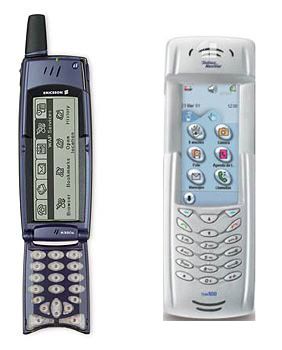
One of the first commercial touchscreen phones was the Ericsson r380s, on the left in the image, launched in the late 90s. It can be considered the driver of touch screens in mobile devices, despite its prohibitive price. On the right side of the image is the TSM100, a phone launched a few years later, with a selling price of €150. It could be considered the first affordable touchscreen phone for the public.
Don’t be too cruel with these models. Keep in mind that they are the great-great-great-grandfathers of current phones. However, we can already observe in the TSM100 the grid icon model, something we will see throughout the article.
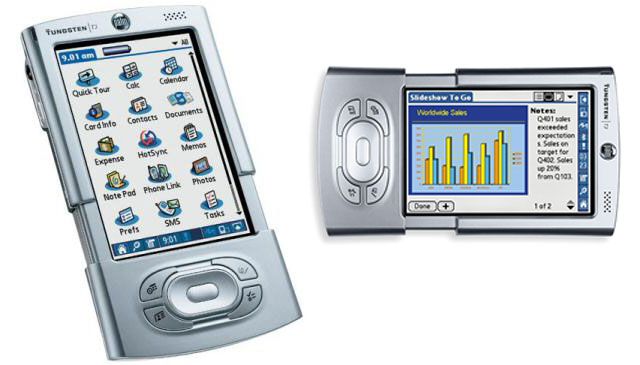
In the image above you can see a Palm Tungsten T3, a little whim I bought in 2003. These devices, PDAs, are the fathers of today’s smartphones. They could be used as an agenda, to send emails, read documents, open Excel sheets, sync data, etc… In this device, we observe the program grid already in its full splendor.
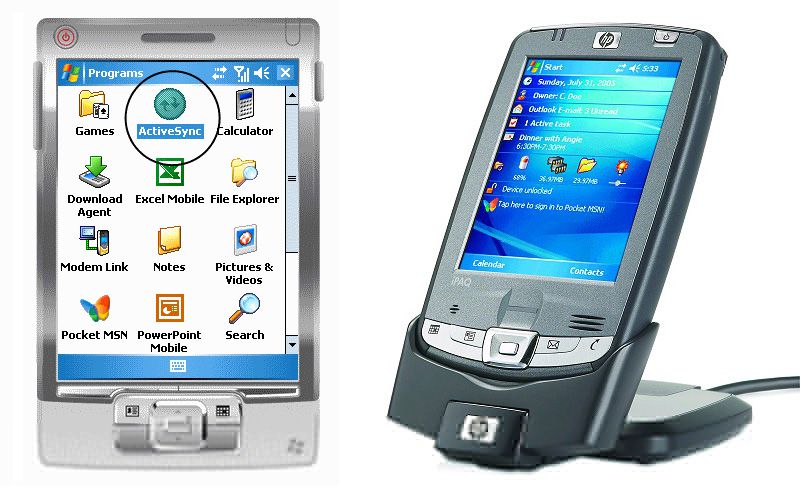
During that time, another great ‘war’ between companies took place. That time it was between Microsoft and Palm for hegemony in PDAs. Despite Palm having superior models, Pocket PCs ended up prevailing, so I ended up buying the HP HX2790, which you can see at the top in its sync dock. On the left side, you see an example of its application menu where (oh, yes!) the program grid appears again.
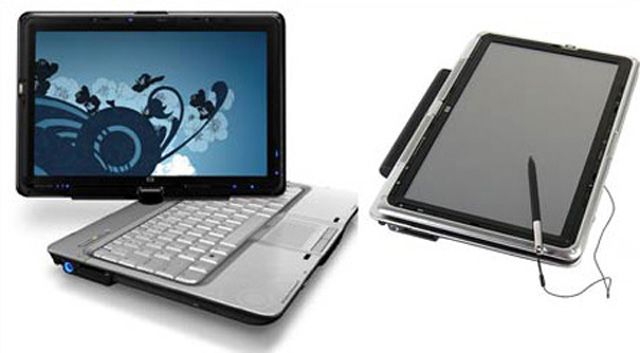
Finally, I present to you the HP TX2000, a Tablet PC I bought in 2007. Its Wacom touch screen had a double layer, so you could interact with your finger or with a pen stored in its base. When you brought the pen close, the ‘normal’ touch screen was deactivated, so you could rest your hand and draw as if it were a notebook. Without a doubt, it is the best laptop I have had and the best experience with a touch device.
And finally, we come to the iPhone, which was launched in June 2007 in the USA, and in 2008 in the rest of the world. Based on what we have seen so far, you can imagine that it did not bring anything unexpected or surprising for industry experts, but rather the logical evolution of devices. However, it must be acknowledged that they managed to implement the user interface exceptionally well, doing away with the pen once and for all. On the other hand, the iPhone was heavily criticized for the absence of a large number of features available in other phones.
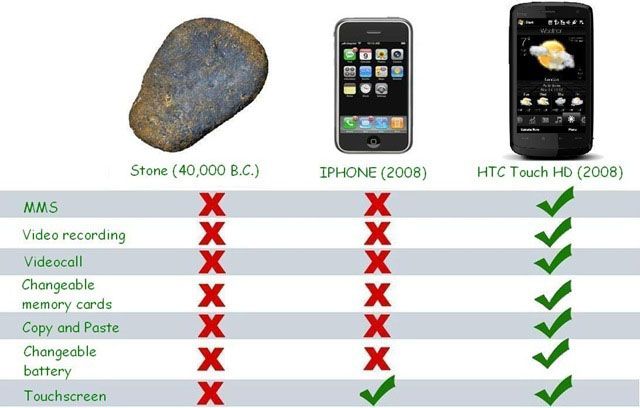
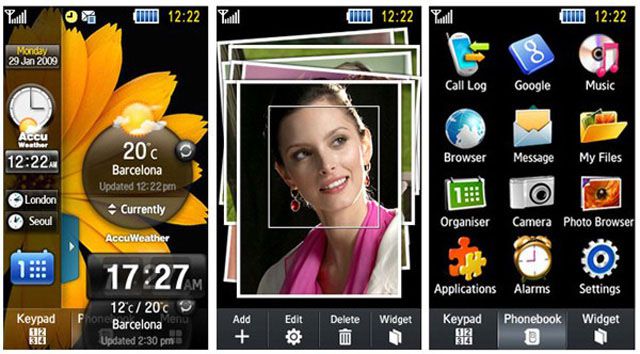
Personally, I am the happy owner of a Samsung Galaxy S2, and it is my favorite ‘Geek’ device. I think it is a technologically superior device that allows me to modify its OS and settings, personalize it, change the ROM, root it, etc… I don’t particularly like how the phone comes ‘out of the box,’ especially I dislike the performance and appearance of Samsung’s interface, TouchWiz (next image). But, at this point, do you really think the app grid was Apple’s idea? (moreover, can you tell me if you see square icons with rounded corners?)
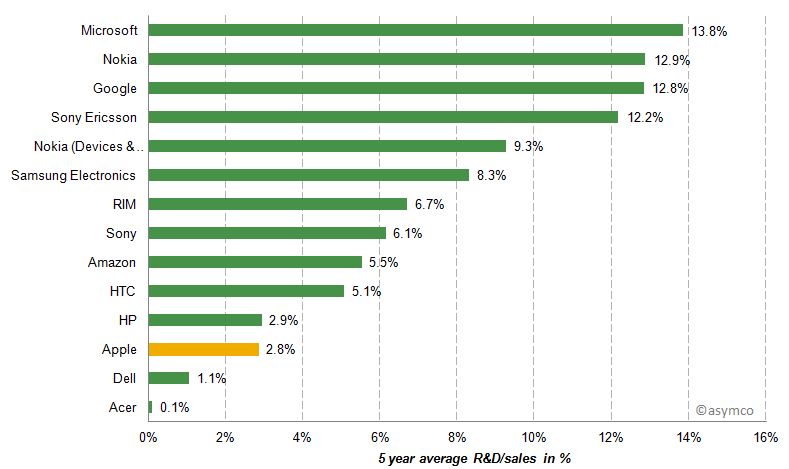
Finally, for those who say that Apple is the innovative company par excellence, and the main engine of the technology industry, say, for example, that the processors of the iPad/iPhone are manufactured by Samsung and the processors of its laptops by Intel. That its iCloud service is built on Microsoft Azure servers. Or that it is the company that obtains the highest sales margin (profit/cost) for its products, and invests the least in R&D (R&D investment/revenue).
The Underlying Problem
In the previous section, we have stated that innovation is not the underlying problem of this lawsuit. The iPhone contributed to the evolution of touch technology and, above all, to its popularization. However, the market is large and it is normal for evolution to be joint and for trends to exist. No company can ‘shield’ a sector and prevent other competitors from entering.
The problem is the US patent system, very different from that which exists in other parts of the world, such as Europe, Australia, or South America. US patents allow patenting a concept, a slogan, and even a word. A specific technological development or a working prototype is not required.
To see the absurdity of the concept, let’s take an example: I have been researching an idea at my university for 4 years. We have done a theoretical study, published some articles, conducted tests, and are now in the phase of building the first prototypes. Well, some enlightened genius from a multinational can have the same idea, go to the US patent office, pay an enormous amount of money, and register the concept. Without development, without research, without prototypes.
When in 2 or 3 years I have a finished and viable product, I will have to pay this company for every device I sell in US territory. Doesn’t make sense, right? This is why large multinationals (Apple, Google, Microsoft, Rim… all of them) are involved in a ‘patent war’ and product withdrawals that make no sense, where they use their lawyers and economic power to paralyze the sector.
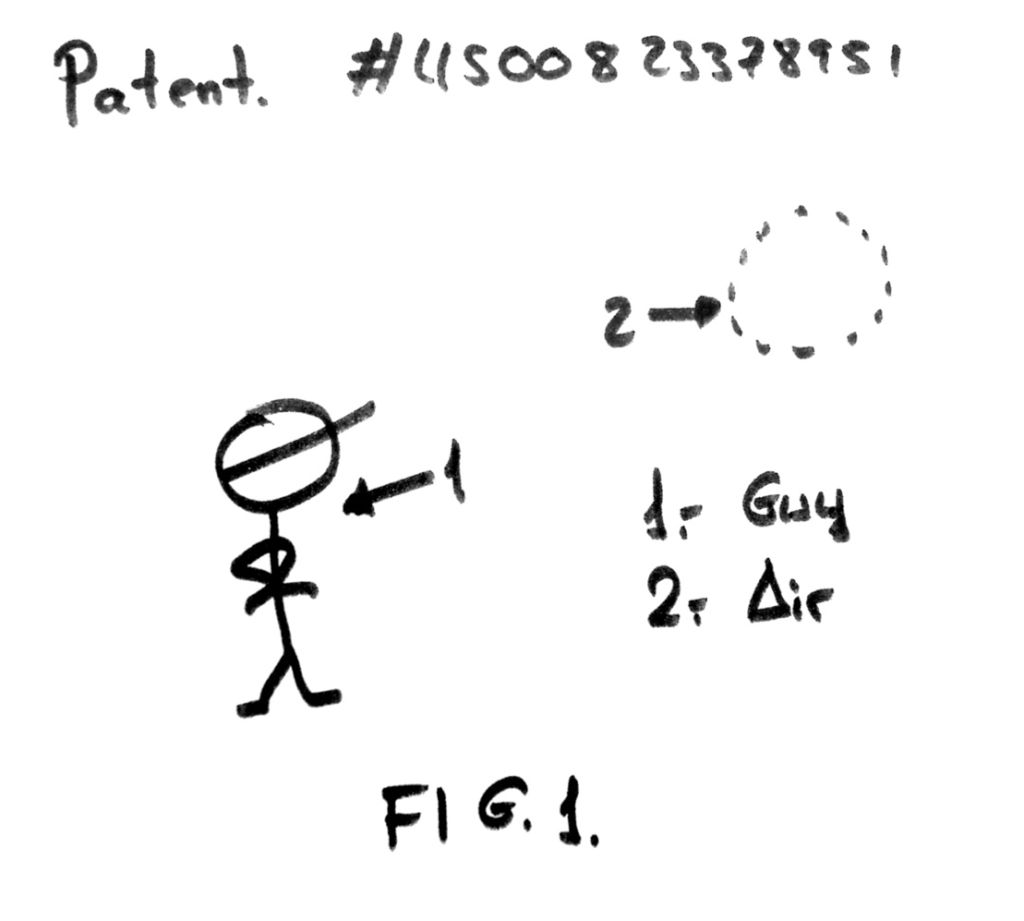
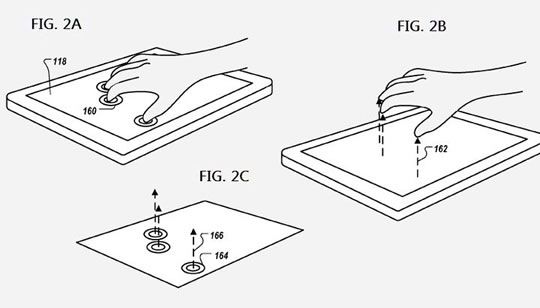
Below I leave you an example of a diagram from an Apple patent. As incredible as it may seem, with four diagrams like this, some text, and a lot of money little more, a patent is acquired in the USA. This is how Apple has patented the square with rounded corners, zooming with two fingers, and tapping on an image to enlarge (someone explain to me how you are going to enlarge an image on a touchscreen phone if not by tapping with a finger). Crazy.
Personal Opinion
Yesterday was a sad day in the history of computing. No technology lover should be happy about this news. Don’t fool yourselves, this patent war will not bring more innovation to the market, the biggest losers are us consumers and the advancement of technology. There are no good guys and bad guys here, it’s not a soccer match, the only ones who lose are the users. I will never understand the Fanboys who defend a company that, like all others, only wants their money.
Large companies are trying to fight with lawyers what they should be achieving in the markets. It is ironic to use these monopoly techniques by someone who so harshly criticized Microsoft for much lesser things. Furthermore, it sets a precedent to sue all kinds of hardware and software companies, since the bounce effect and pinch/zoom are common gestures on any touch screen.
To give a simple example. When I buy a car, I look for the one I like aesthetically, its technical characteristics, its power, and its price. There are users who will like a certain color, certain design lines, bigger, smaller… Some will prefer to pay more for a brand, others will want maximum efficiency for their money, and a few will want a phone they can take to their workshop, adjust, and squeeze out a few extra horsepower. This is the correct way in which companies should compete with the usual techniques of marketing, brand, technical features, design, etc…
Well, essentially what has happened is that Apple has been allowed to patent the wheel (design) and turning left (software) in the USA. From now on, anyone who wants to design a car will have to pay them for having wheels (you can always put on tracks, although we know it’s a system that doesn’t work). Moreover, even if you design tricycles and avoid the first restriction, whenever you turn left, you will have to pay Apple (but it’s impossible to drive without turning left at some point!… believe me, we know).
Finally, let’s say that no one considers, because it seems simply absurd, that owners of a brand A car would habitually go to other car owners saying ‘your car is crap,’ ‘I don’t like your car,’ ‘my car is cooler.’ It wouldn’t be polite, especially if it turns out they have the same engine and you don’t even dare to race. Well, this is the usual situation with Fanboys, unconditional support for a company (something that, as I said, I will never understand).
If you’ve made it this far, you are truly brave. It’s clear that you are interested in the topic, so take the opportunity to leave us your opinion or comment! And to lighten the mood, I leave you a humorous image parodying the US patent system.