

We are starting a new course dedicated to designing and creating our own PCB boards to use in our electronics projects.
Until relatively recently, hiring the manufacturing of a PCB was an expensive process, requiring long runs and investments of several hundred euros. Therefore, it was out of reach for the domestic and #maker sphere.
Fortunately, things have changed a lot in recent years. Online custom PCB manufacturing services are becoming increasingly common, allowing us to have small series (of 5 units) with professional quality at a very low cost. Now we can have series of 5-10 units for a few euros, for less than one euro per board.
Changes in PCB design software have also contributed. Until recently, it was exclusively commercial with licensing costs of several thousand euros. Currently, we have good and powerful free solutions, and even Open Source, for board design.
As a result of both, we can now have custom PCBs, designed by ourselves, with industrial quality and for less than one euro per board!, available for our projects in 2-3 weeks of shipping.
Something that was unthinkable until a few years ago, and that not only delights every electronics enthusiast, but will take your projects to another level, making them much more professional, robust and easier to assemble.
So we are going to create a new section dedicated to designing and creating our own PCBs, starting from scratch and reaching the point of obtaining the necessary files for their manufacturing.
We will see everything in detail in upcoming posts. But let’s not get ahead of ourselves so soon and start by explaining (as we like on the blog) from the beginning. Which in this case translates to: What is a PCB?
What is a PCB?
A printed circuit board or PCB (Printed Circuit Board) is a compact system for constituting electrical circuits that reduces the need for wires, generating robust and small circuits.
Printed circuit boards were invented in 1936 by Austrian engineer Paul Eisler, and were quickly adopted, largely pushed by the context of the Second World War.
One consequence of its Anglo-Saxon origin is the continued use of imperial units. Get used to it, because it’s the standard in PCBs.
Nowadays we are more than used to seeing PCB boards everywhere. From small ones, like in domestic electronics modules, inside your smartphone, or your computer’s motherboard.
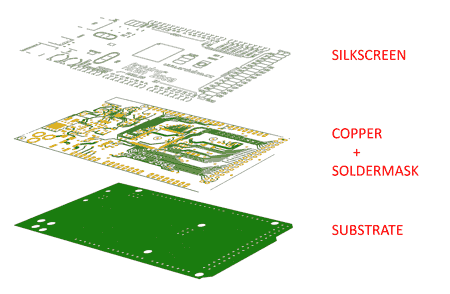
PCBs are also often seen as very complicated elements, accessible only to electronics professionals. And yes, they can become very complex. But in this section, we are going to demystify this and see that anyone can design their own PCB board.
A PCB is made up of layers of copper insulated from each other that configure electrical circuits. In the upcoming posts of the series, we will go into detail on each of these aspects, but for now, let’s stick with this summary.
On the PCB, we will install / solder the electronic components, which can be PTH (Plated-Through Holes) or SMD (Surface Mounted Device). In both cases (PTH and SMD) there is a wide variety of components. Resistors, capacitors, coils, transistors, integrated circuits.
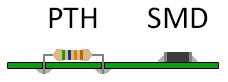
The conductive tracks of the PCB together with the installed components form the final electrical circuit. If we don’t have a PCB, we can wire the components together, use a breadboard or a protoboard and solder. The PCB saves us all that work.
It avoids the mess of wires. The connecting and disconnecting. The “this pin bent when I removed it”. The “check where this wire comes from”. The “I soldered two pins together”. The “this connection has electrical noise”. And, above all, the “this doesn’t work” and the “this broke”.
Logically, most of the difficulty lies in the circuit design. The greater your knowledge of electronics, the more complex and useful the boards you make will be (that also happens if you use a breadboard).
But, as we see and despite what it might seem, the PCB itself is a simple concept. Simply, the conductive tracks save us from having a bunch of wires and give us a robust and secure way to build our electronic circuits.
Conclusion
That’s it for the introduction post to this new PCB design section where we have seen what they are and why we shouldn’t be afraid of them. Nowadays, anyone can get a custom-made PCB.
Although, of course, this is the first post and we still have a lot to see. We’ve just started! In the next post, we will delve into the composition of a PCB, looking at the layers and vias. See you soon!
